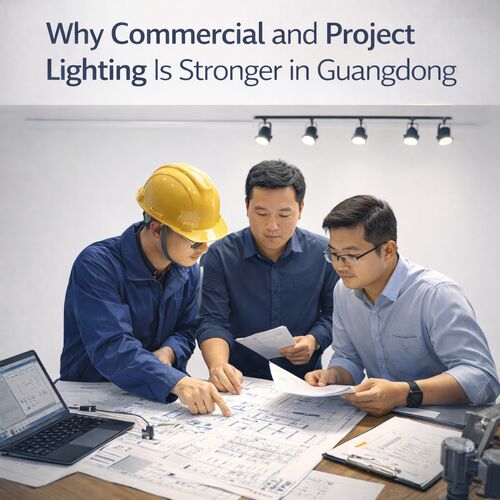
Many buyers treat commercial and project lighting as a scaled-up version of bulb sourcing. This assumption often leads to delays, cost overruns, specification drift, and on-site coordination issues.
Project lighting follows a fundamentally different logic from standardized lamps. Guangdong fits that logic better than any other region in China.
Commercial and project lighting is stronger in Guangdong because this supply chain is built for system integration, customization, and rapid engineering response—not for frozen SKUs or long production runs.
Understanding this distinction helps global buyers choose the right region before tender approval and site installation, rather than attempting to fix problems after shipment.
Structural Characteristics of Project-Based Lighting Products
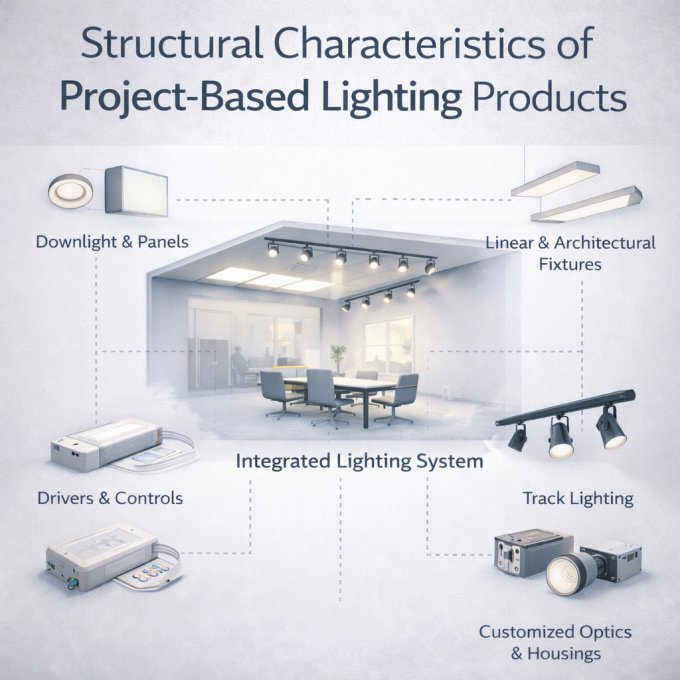
Project lighting behaves very differently from standardized bulb manufacturing. The product structure itself forces a different supply chain model.
Project-based lighting is defined by variability, system integration, and coordination—not by volume efficiency or repetition.
What makes project lighting structurally different
Commercial and project lighting typically includes:
These products are rarely supplied as standalone items. They are designed, delivered, and installed as part of an integrated lighting system.
Key structural characteristics include:
| Characteristic |
Impact on Manufacturing |
| Custom specifications |
Frequent drawing and BOM changes |
| System integration |
Driver, control, optics coordination |
| Project deadlines |
Compressed lead times |
| Installation constraints |
Mechanical and mounting adaptation |
| Visual consistency |
Tight bin and batch control |
Unlike bulbs, project lighting is not replaced individually. A failure affects entire spaces, not single luminaires.
Short runs with high variation
Most project orders involve:
In this environment, flexibility matters more than yield optimization.
Rigid production models designed for long runs struggle to adapt without disruption.
Specification-driven production
Project lighting is controlled by:
- technical drawings
-
lighting calculations
-
control protocols
-
compliance documentation
Factories must interpret and respond to engineering inputs, not simply produce catalog SKUs.
This structural requirement favors regions with dense engineering resources and fast supplier coordination.
Guangdong’s Advantage in Complex Lighting Systems
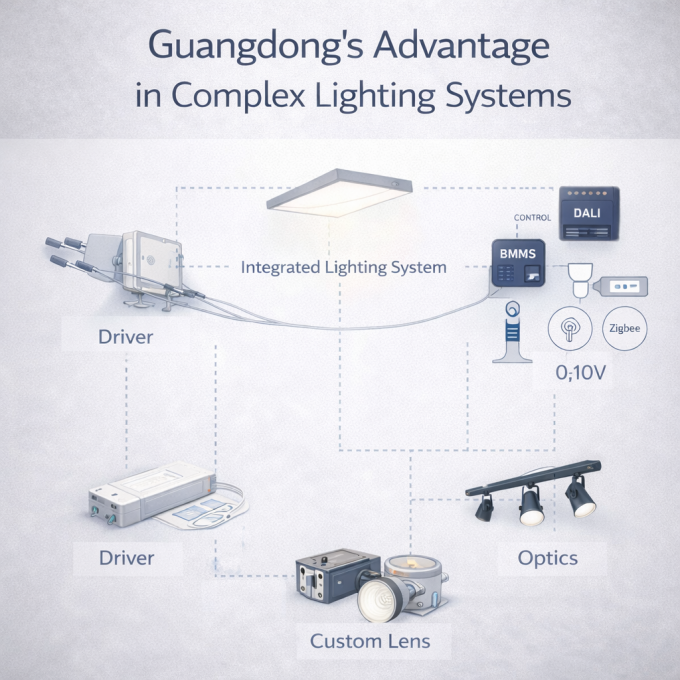
Guangdong’s dominance in project lighting is not accidental. It is structural.
Guangdong excels in commercial lighting because its ecosystem integrates electronics, optics, mechanics, and controls within a tightly connected regional network.
Electronics-first foundation
Guangdong—especially Shenzhen, Zhongshan, and surrounding cities—developed alongside China’s electronics industry.
This created deep expertise in:
In project lighting, a fixture is not just a luminaire. It is an electronic system.
Regions where electronics are secondary struggle to support this complexity.
Control protocol integration
Modern commercial projects often require compatibility with:
Guangdong factories routinely collaborate with driver and control vendors to implement these requirements quickly.
This capability is difficult to replicate in supply chains optimized for standardized lamps.
Mechanical and optical customization
Guangdong’s proximity to metalworking hubs such as Foshan enables:
These adjustments are common when:
Mechanical adaptation is treated as a normal part of production—not an exception.
System-level engineering mindset
Guangdong manufacturers typically evaluate products by asking:
This system-level thinking aligns with real project execution.
Customization, Small Batches, and Rapid Iteration
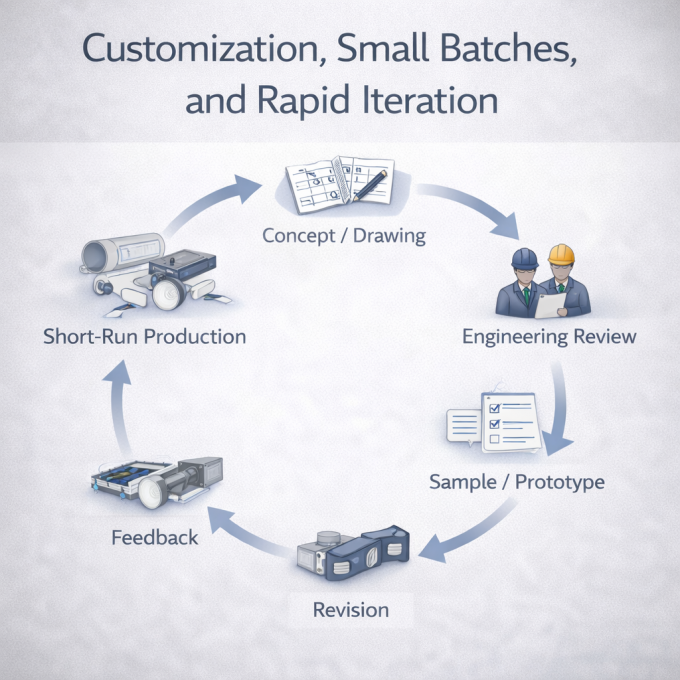
In project lighting, customization is not a feature. It is the baseline.
Guangdong supply chains are optimized for frequent customization, small batch production, and rapid iteration without resetting the entire factory.
Handling small batches without disruption
Guangdong factories are structured to manage:
This allows buyers to:
In standard-focused factories, small batches reduce efficiency.
In Guangdong, they are expected.
Fast sampling and revision cycles
A typical project workflow in Guangdong looks like this:
- Buyer submits drawings
-
Factory reviews and proposes adjustments
-
Sample produced within days
-
Feedback incorporated immediately
-
Production proceeds quickly
This responsiveness is critical when:
Engineering responsiveness
Guangdong factories usually maintain:
This enables rapid answers to questions such as:
These are routine project questions, not exceptions.
Managing design volatility
Flexibility introduces design volatility.
Specifications may:
This is not a flaw—it is the cost of speed.
Guangdong rewards technically engaged buyers who manage documentation actively.
Cost and Risk Considerations for Buyers
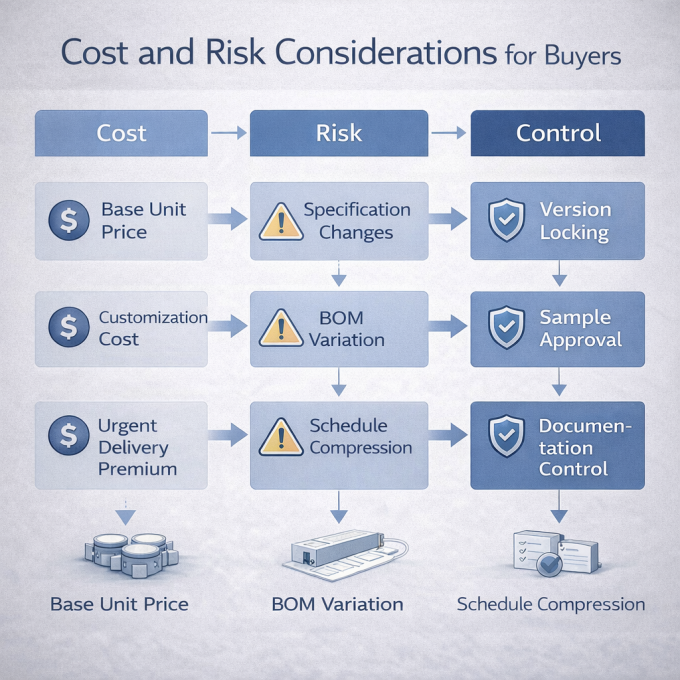
Guangdong’s strengths come with a different risk profile.
Project lighting in Guangdong trades predictability for flexibility. Buyers must actively manage cost, documentation, and validation.
Cost structure realities
Project pricing in Guangdong is influenced by:
| Cost Factor |
Typical Behavior |
| Base unit price |
Often competitive |
| Customization |
Variable |
| Urgent delivery |
Premium |
| BOM adjustments |
Possible |
Buyers focused only on unit price often underestimate total project cost.
Specification drift risk
Because designs evolve, risks include:
Mitigation requires:
Speed compresses risk—it does not eliminate it.
Quality control complexity
Project lighting QC is inherently more complex due to:
Guangdong factories rely on:
- functional testing
-
visual inspection
-
in-process checks
Buyers should expect involvement in:
- sample approval
-
pre-shipment validation
This is normal in project-based supply chains.
Buyer Profiles Best Suited for Guangdong Supply Chains

Guangdong performs best when buyer behavior aligns with its strengths.
Guangdong supply chains suit buyers who manage projects, accept technical coordination, and value responsiveness over long-term SKU stability.
Best-fit buyer types
- engineering contractors and project integrators
-
architectural lighting brands
-
commercial lighting solution providers
-
smart building and system-oriented companies
These buyers benefit from Guangdong’s speed and integration depth.
Buyers who may struggle
Guangdong is less suitable for buyers who:
Mismatch creates friction, not factory failure.
Strategic sourcing reality
Many mature buyers adopt a dual-region strategy:
This reflects how China’s lighting supply chains are naturally structured.
Conclusion
Commercial and project lighting is stronger in Guangdong because this supply chain is optimized for system complexity, customization, and rapid engineering response rather than standardized mass production.
Choosing Guangdong is not about chasing innovation.
It is about matching supply chain behavior to product structure.
While Teco’s core manufacturing base focuses on standardized LED bulbs in Zhejiang, we work closely with Guangdong-based partners for commercial, project, and custom lighting solutions when flexibility and system integration are required.
We support B2B buyers by:
If you are sourcing commercial or project lighting from Guangdong:
Email: [email protected]
Website: www.tecolite.com
Tell me your project type, timeline, and customization depth.
I will help you decide whether Guangdong is the right supply chain—and how to manage it correctly.


 Your message must be between 20-3,000 characters!