Many LED sourcing problems are not caused by poor factories or weak quality control.
They come from choosing the wrong supply chain for the wrong business model.
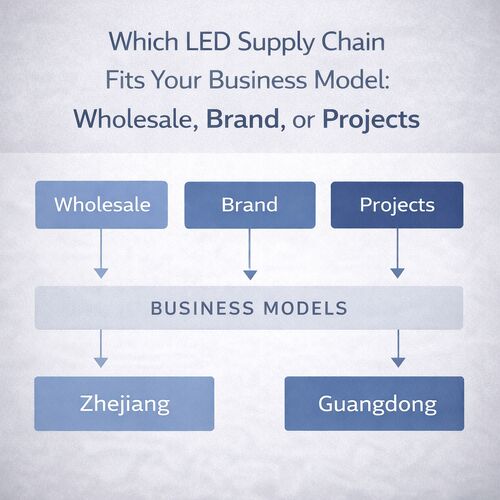
Different LED business models—wholesale, private-label brands, and project-based lighting—operate under fundamentally different pressures. In China, this difference is most clearly reflected between Zhejiang and Guangdong, two regions optimized for very different types of LED business.
Zhejiang and Guangdong serve different commercial logics. The right choice depends more on how you sell than on what you buy.
Price sensitivity, SKU stability, customization depth, documentation discipline, and delivery rhythm are not the same across business models. This article explains how each model actually works, which supply chain fits it best, and where buyers most often make costly mistakes.
Wholesale-Oriented LED Business Models
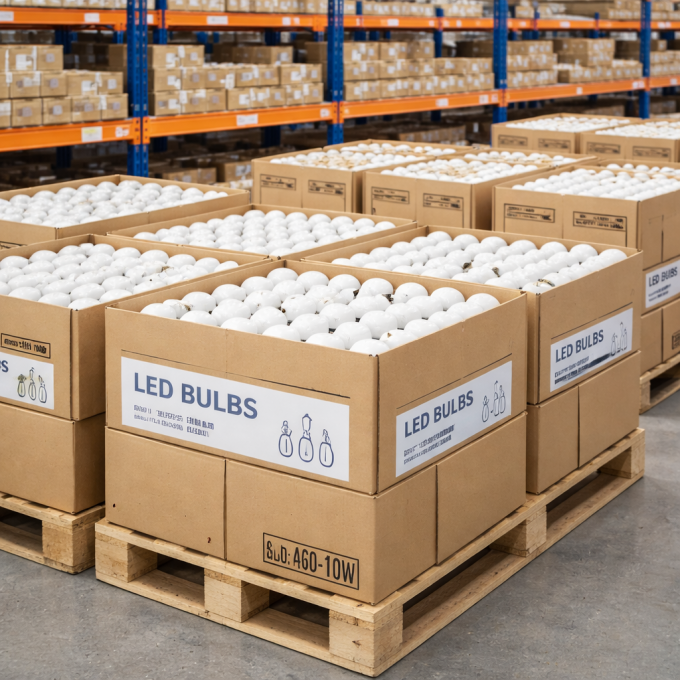
Wholesale businesses live on repetition, margin control, and operational stability. Speed and novelty matter far less than predictability.
Wholesale LED businesses require stable SKUs, consistent quality, and long-term cost control—not rapid customization.
How wholesale LED businesses really operate
A typical wholesale model involves:
Profit depends on:
- turnover speed
-
purchase consistency
-
low return rates
Any disruption in product consistency directly damages margin.
What wholesalers require from the supply chain
Wholesale buyers depend on suppliers that can deliver:
| Requirement |
Why It Matters |
| Frozen specifications |
Avoid re-approval cycles |
| Stable BOM |
Prevent cost drift |
| Consistent appearance |
Reduce customer complaints |
| Predictable lead times |
Inventory planning |
| Low defect rate |
Protect margin |
Frequent design changes or silent component substitutions create operational chaos.
Why Zhejiang fits wholesale sourcing best
Zhejiang supply chains are structurally aligned with wholesale logic.
They emphasize:
Factories are comfortable producing the same model for years with only internal yield improvements.
This protects wholesalers from:
- unexpected spec changes
-
re-certification risk
-
batch-to-batch variation
Where wholesalers struggle in Guangdong
Guangdong factories often operate with:
For wholesale buyers, this flexibility creates risk.
Common issues include:
These are structural issues, not individual factory failures.
Wholesale takeaway:
If your revenue depends on repeat sales of standardized LED bulbs, Zhejiang is usually the safer foundation. Guangdong may appear competitive initially, but long-term stability favors Zhejiang.
Brand and OEM-Oriented LED Business Models
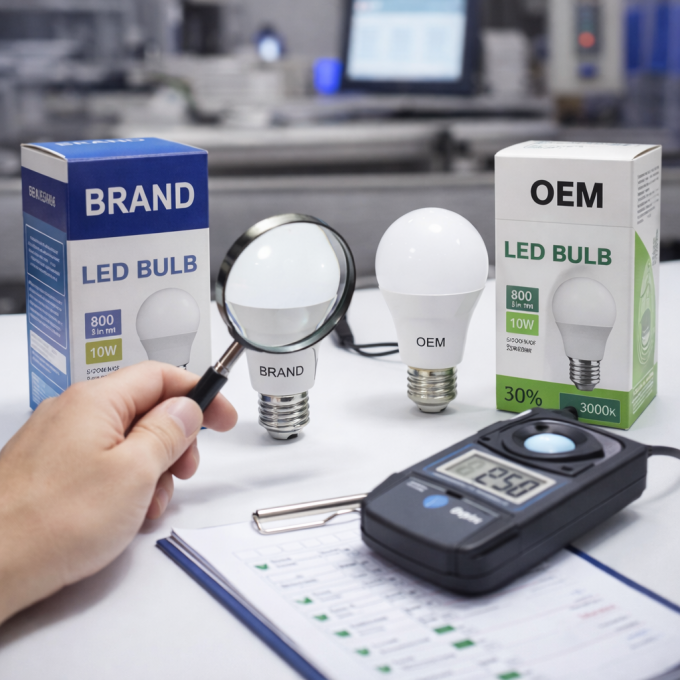
Brand owners operate between wholesale and projects. They need differentiation, but cannot afford instability.
Brand and OEM businesses require controlled customization, stable quality, and suppliers that respect long-term product identity.
How brand-led LED businesses function
Brand owners typically:
Unlike wholesalers, brand owners care deeply about:
- appearance consistency
-
performance claims
-
customer perception
A single quality issue can damage years of brand investment.
What brand buyers need from suppliers
| Requirement |
Reason |
| Controlled customization |
Differentiation without chaos |
| Long-term SKU continuity |
Brand consistency |
| Transparent change control |
Protect certification and claims |
| Stable optical and thermal performance |
Customer trust |
| OEM discipline |
Private-label integrity |
Brand buyers want progress without disruption.
Zhejiang’s role for brand-led businesses
Zhejiang is strong for brands when:
- products are standardized bulbs or spotlights
-
differentiation is material, optics, or quality-based
-
long-term continuity matters
Zhejiang factories tend to:
This suits brands selling into compliance-heavy markets such as Europe, Japan, and the Middle East.
Guangdong’s role for brand-led businesses
Guangdong can be powerful for brands that:
It enables:
However, brands must actively manage:
Brand takeaway:
Zhejiang protects long-term product identity. Guangdong enables differentiation. Mixing both without strategy creates brand risk.
Project and Contract-Based LED Business Models

Project businesses operate under time pressure, specification changes, and coordination complexity.
Project-based LED businesses require flexibility, engineering responsiveness, and system integration above all else.
How project lighting businesses operate
Project buyers include:
Their workflow involves:
- tenders and drawings
-
client revisions
-
site constraints
-
installation deadlines
Products are rarely final until late in the process.
What project buyers require from suppliers
| Capability |
Why It Matters |
| Drawing interpretation |
Fit real site conditions |
| Rapid design modification |
Respond to change |
| Driver and control integration |
System compatibility |
| Small-batch production |
Reduce inventory risk |
| Fast delivery |
Meet project timelines |
Project lighting punishes rigidity.
Why Guangdong dominates project lighting
Guangdong’s supply chain was built for exactly this environment.
Its strengths include:
Factories are accustomed to:
This behavior is normal in projects.
Why Zhejiang struggles with projects
Zhejiang factories are optimized for:
- stability
-
repetition
-
frozen BOMs
When exposed to frequent changes, they may slow down or increase cost sharply.
This is not incompetence—it is structural mismatch.
Project takeaway:
If your business depends on tenders, customization, and fast response, Guangdong is almost always the better fit.
Matching Business Models with Zhejiang or Guangdong
There is no universally “best” LED supply chain.
The correct supply chain depends on your business model—not factory size or quoted price.
Business model vs regional fit
| Business Model |
Best Fit |
Core Reason |
| Wholesale |
Zhejiang |
Stability and repeatability |
| Private-label bulb brand |
Zhejiang |
Long-term consistency |
| Fixture or smart lighting brand |
Guangdong |
Design and integration |
| Project / contract |
Guangdong |
Flexibility and speed |
| Mixed portfolio |
Split sourcing |
Risk isolation |
Why misalignment causes problems
When business model and supply chain do not match, buyers face:
- unstable pricing
-
QC disputes
-
missed deadlines
-
internal rework
-
damaged customer trust
These costs often surface only after scale.
The myth of “one supplier for everything”
Bulbs and fixtures behave differently.
Wholesale and projects move at different speeds.
Forcing one supply chain to serve all needs creates compromise everywhere.
How mature buyers operate
Experienced buyers often:
This is not inefficiency—it is risk control.
Common Mistakes in LED Supply Chain Selection
Most sourcing failures repeat the same patterns.
The biggest mistakes come from misunderstanding how supply chains behave under different business pressures.
Mistake 1: Choosing based on unit price only
Hidden costs appear later through BOM changes and QC disputes.
Mistake 2: Assuming innovation equals suitability
Innovation benefits projects, but destabilizes wholesale programs.
Mistake 3: Treating bulbs and fixtures the same
Bulbs require discipline. Fixtures require integration.
Mistake 4: Underestimating internal capability
Guangdong requires buyer-side technical control.
Mistake 5: Ignoring long-term behavior
Problems often appear in year two or three, not the first order.
Final Decision Summary
If your business relies on stability, repetition, and margin control, Zhejiang is usually the right foundation.
If your business depends on customization, speed, and system integration, Guangdong is structurally stronger.
If you operate across multiple channels, split sourcing is often the most resilient strategy.
Conclusion
The strongest LED supply chain is the one that fits your business model:
Zhejiang for stability-driven wholesale and brands, Guangdong for customization-driven projects, and split sourcing for mature, diversified businesses.
Most sourcing problems do not appear in the first order—they appear in the second or third year.
Teco works with global B2B buyers across wholesale, brand, and project channels, helping them match the right LED supply chain to the right business model.
Our core manufacturing base in Zhejiang focuses on:
We also coordinate with Guangdong-based partners for:
If you are reassessing your LED sourcing strategy:
Email: [email protected]
Website: www.tecolite.com
Tell me how you sell.
I will help you choose the supply chain that actually supports your business.


 Your message must be between 20-3,000 characters!