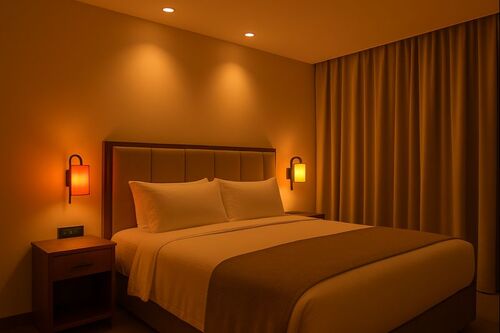
Many buyers think they are purchasing “circadian lighting,” but end up with nothing more than warm white bulbs and vague marketing claims. The result is poor sleep feedback, project complaints, and wasted budget.
Buying GU10 circadian bulbs means understanding real biological parameters, not trusting labels or color temperature alone.
GU10 can support circadian and wellness lighting, but only when expectations are realistic and technical details are checked carefully. This guide focuses on what actually matters when sourcing GU10 circadian-capable bulbs, especially for B2B buyers, hotels, and retrofit projects.
Key Parameters That Matter?
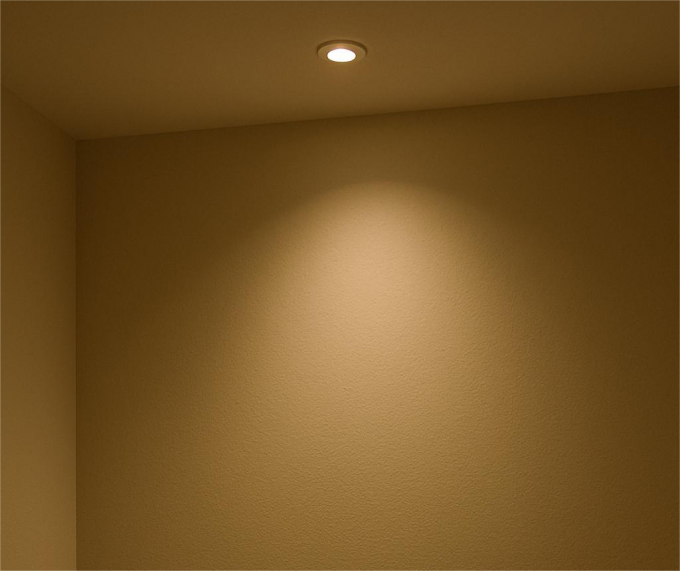
Many GU10 buyers focus on wattage and beam angle first. For circadian lighting, that approach is backward.
Circadian performance depends on spectrum, dimming behavior, and timing compatibility more than raw brightness.
Spectrum quality, not just CCT
Color temperature is only a rough indicator. Two 2700K GU10 bulbs can behave very differently biologically.
What matters is spectral power distribution, especially energy around 460–480 nm.
| Parameter |
Why It Matters |
| Blue peak intensity |
Drives melatonin suppression |
| Red / amber presence |
Supports night use |
| Spectral smoothness |
Reduces biological noise |
Harvard Medical School confirms that blue light in the 460–480 nm range suppresses melatonin, even at low brightness.
Source: https://health.harvard.edu/staying-healthy/blue-light-has-a-dark-side
A “warm” GU10 with a strong blue spike is not circadian-friendly.
Dimming behavior at low levels
Circadian lighting relies heavily on low-light conditions.
Key checks:
Many GU10 bulbs dim visually but become biologically worse when dimmed due to driver instability.
Flicker and waveform control
Flicker is often ignored, but it affects comfort and nervous system response.
IEEE Std 1789 confirms that even invisible flicker can cause discomfort and stress.
Source: https://ieeexplore.ieee.org/document/6575776
For circadian and wellness use, flicker performance should be specified, not assumed.
Beam angle and vertical exposure
Circadian response depends on vertical illuminance at eye level, not floor lux.
Source: WELL Building Standard v2
https://standard.wellcertified.com/light
Narrow-beam GU10 lamps may look bright but fail biologically because light never reaches the eyes properly.
| Beam Angle |
Circadian Suitability |
|
Poor |
| 36° |
Moderate |
| ≥60° |
Better |
Consistency over time
Circadian lighting fails when output drifts.
Ask suppliers about:
Inconsistent spectrum equals inconsistent biological signaling.
What ‘Circadian-Capable’ Really Means for GU10?
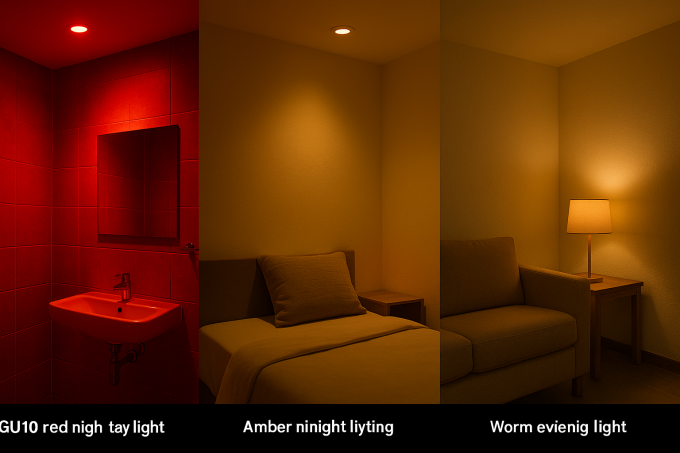
The phrase “circadian-capable” is widely misused. GU10 cannot do everything, and that is fine.
Circadian-capable GU10 means supporting specific circadian phases, not delivering full circadian entrainment alone.
What GU10 can realistically do
GU10 works well for:
- evening relaxation lighting
-
night-time navigation lighting
-
localized circadian support
-
retrofit improvement projects
It performs best in discrete spectrum stages, not continuous tuning.
What GU10 cannot do
GU10 should not be expected to:
- simulate outdoor daylight
-
provide high melanopic lux
-
act as primary circadian driver
-
meet healthcare circadian standards alone
Trying to force GU10 into these roles leads to disappointment.
Practical definition for buyers
A GU10 bulb is circadian-capable if it meets these conditions:
| Requirement |
Why |
| Low-blue or blue-free option |
Protects melatonin |
| Stable dimming |
Supports night use |
| Flicker-safe |
Improves comfort |
| Suitable beam angle |
Delivers vertical exposure |
| Time-based compatibility |
Works with schedules |
If a product fails any of these, it should not be labeled circadian-capable.
Beware of marketing shortcuts
Common phrases to question:
- “Circadian-inspired”
-
“Human-centric lighting”
-
“Healthy warm light”
Ask for data, not adjectives.
If spectral graphs are missing, assume they are unfavorable.
Common Buying Mistakes?
Most procurement mistakes come from applying traditional lighting logic to circadian use.
The biggest errors are over-trusting labels, under-checking drivers, and ignoring biological limits.
Mistake 1: Buying based on CCT alone
CCT does not equal circadian performance.
A 2700K bulb can still suppress melatonin if the blue peak is strong.
Always request:
Mistake 2: Assuming dimming solves night lighting
Dim white light is still white light.
Studies show melatonin suppression can occur at very low blue-light exposure, even under 10 lux.
Source: Journal of Clinical Endocrinology & Metabolism
https://academic.oup.com/jcem/article/100/6/2209/2836073
For true night use, red or blue-free light is required.
Mistake 3: Ignoring driver design
GU10 drivers determine:
- flicker
-
dimming stability
-
spectral behavior
Many low-cost GU10 bulbs use minimal drivers that:
- lose regulation at low current
-
flicker when dimmed
-
distort spectrum
Driver quality is invisible but decisive.
Mistake 4: Overloading GU10 expectations
GU10 is not a circadian system. It is a component.
Buyers fail when they expect:
- full circadian automation
-
daylight simulation
-
biological entrainment
GU10 should support, not lead.
Mistake 5: No application-based planning
The same GU10 bulb cannot serve:
- bathrooms at night
-
living rooms in evening
-
workspaces in morning
Each scenario needs a different spectrum and control logic.
Buying “one SKU for all” is a classic procurement shortcut that breaks circadian intent.
Procurement Checklist?
Buying GU10 circadian bulbs should follow a checklist, not instinct.
A structured procurement process reduces biological risk and avoids false circadian claims.
Technical checklist
| Item |
Check |
| Spectral data available |
Yes / No |
| Blue peak suppressed |
Yes / No |
| Red or amber option |
Yes / No |
| Flicker performance stated |
Yes / No |
| Stable low-level dimming |
Yes / No |
| Beam angle ≥36° |
Yes / No |
| Driver type specified |
Yes / No |
If more than two items are “No,” the product is not suitable.
Application checklist
| Question |
Why It Matters |
| Is this for evening or night? |
Determines spectrum |
| Is dimming required? |
Affects driver choice |
| Is retrofit required? |
Limits system options |
| Is automation planned? |
Affects compatibility |
| Is wellness a selling point? |
Raises expectations |
Circadian lighting fails when application context is ignored.
Supplier evaluation checklist
| Supplier Question |
Red Flag |
| Can you provide SPD data? |
“Not necessary” |
| How is flicker controlled? |
“It’s LED, no flicker” |
| What happens at 5% dim? |
No clear answer |
| Are certificates verified? |
PDFs without traceability |
| Is spectrum customizable? |
“Standard only” |
A supplier who avoids technical detail will avoid responsibility later.
Cost reality check
Circadian-capable GU10 bulbs cost more than standard ones.
That cost comes from:
- better drivers
-
tighter binning
-
spectrum control
-
testing
If price is close to commodity GU10, expectations should be lowered.
Conclusion
Buying GU10 circadian bulbs requires understanding spectrum, control limits, and real biological effects, not relying on color temperature or marketing claims.
Teco manufactures GU10 LED spotlights designed for circadian-aware and wellness-focused applications, especially in hospitality and residential retrofit projects.
We work B2B only, supporting buyers who need stable quality, real technical data, and reliable delivery.
Our factory in China operates four production lines and supports:
- OEM and ODM projects
-
warm, amber, and red GU10 solutions
-
dimming and driver matching
-
compliance for Europe, Middle East, and Southeast Asia
If you are sourcing GU10 bulbs for a circadian or wellness project:
Email: [email protected]
Website: www.tecolite.com
Tell me your application and constraints.
I will help you avoid the common mistakes before they cost you.


 Your message must be between 20-3,000 characters!