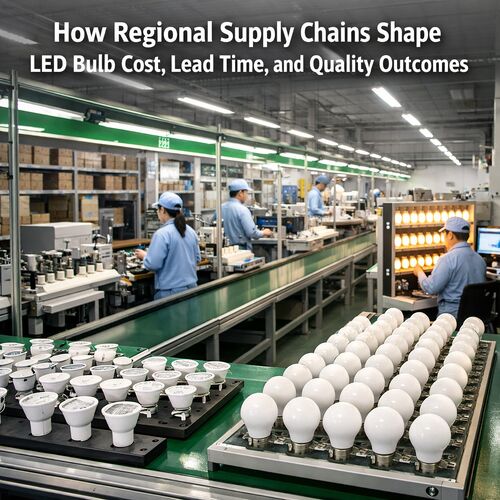
Many B2B buyers compare LED bulbs primarily by unit price. Months later, they encounter unstable lead times, inconsistent quality, and rising hidden costs. In most cases, the problem is not the bulb itself—it is the regional supply chain structure behind the product.
In China’s LED industry, regional supply chains behave differently.
For standardized LED bulbs such as GU10, MR16, and A60, regions like Zhejiang prioritize stability and repeatability, while more flexible regions such as Guangdong prioritize responsiveness and adjustment. These structural differences directly shape how costs accumulate, how reliably orders ship, and how consistent quality remains over time.
Understanding this relationship helps buyers avoid false savings and choose suppliers that support long-term programs rather than short-term pricing wins.
Cost Composition in LED Bulb Manufacturing
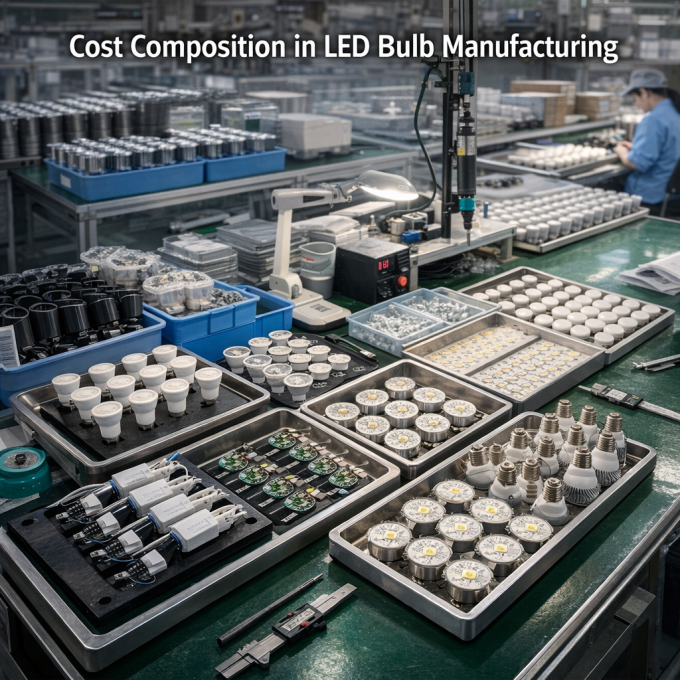
LED bulb cost is not a single number. It is the result of structural decisions embedded in the supply chain.
In stability-oriented regions such as Zhejiang, cost control focuses on process discipline and long-term predictability. In flexibility-oriented regions such as Guangdong, cost control often emphasizes short-term adaptability. Both approaches can produce similar initial quotes, but their long-term behavior differs significantly.
What actually makes up LED bulb cost
A typical LED bulb cost includes:
| Cost Element |
Description |
| LED chips |
Light source consistency and binning |
| Driver |
Electrical stability and lifespan |
| Housing |
Thermal and mechanical structure |
| Assembly labor |
Yield and repeatability |
| Quality control |
Inspection, aging, and testing |
| Certification |
Compliance maintenance |
| Overhead |
Factory operation costs |
| Risk buffer |
Defects, rework, returns |
The quoted unit price reflects how these elements are managed, not just how much they cost.
Structural cost behavior by region
Stability-driven supply chains typically emphasize:
Flexibility-driven supply chains often rely on:
Both models can appear competitive initially. Only one remains predictable over time.
Upfront savings versus structural cost
Low initial pricing often comes from:
- reduced aging tests
-
looser binning tolerance
-
minimal QC buffers
These choices lower the first invoice but increase downstream risk.
Stable supply chains invest more upfront to prevent downstream cost rather than reacting to it later.
Why buyers misjudge cost
Most buyers compare:
Few buyers compare:
Regional supply chain behavior determines which costs remain hidden until scale exposes them.
Lead Time Reliability and Production Planning
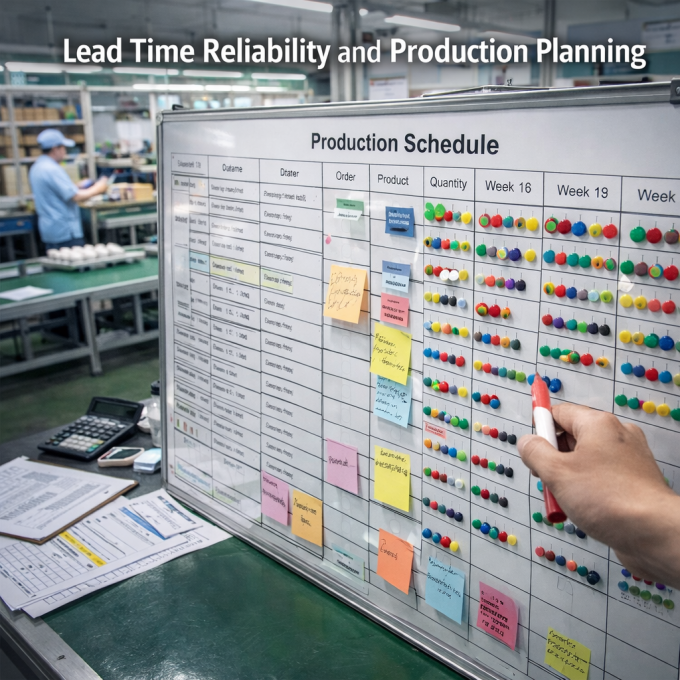
Lead time issues are rarely caused by a single late shipment. They come from how factories plan production and allocate capacity.
Stable regions such as Zhejiang optimize for production rhythm and commitment protection. Flexible regions such as Guangdong optimize for rapid adjustment and reprioritization.
What drives LED bulb lead time
Key lead time drivers include:
- LED chip availability
-
driver sourcing
-
housing production
-
assembly capacity
-
aging and QC duration
The difference lies in how tightly these steps are coordinated.
Long-run versus short-run production logic
Some regions favor:
- long production runs
-
fewer SKUs
-
predictable schedules
Others favor:
- mixed SKUs
-
short runs
-
frequent changeovers
Long-run logic reduces planning noise.
Short-run logic increases responsiveness but reduces predictability.
Speed versus reliability
Fast is not the same as reliable.
| Aspect |
Stable Supply Chains |
Flexible Supply Chains |
| Quoted lead time |
Moderate |
Often shorter |
| Delivery accuracy |
High |
Variable |
| Schedule changes |
Rare |
Common |
| Priority shifts |
Low |
Frequent |
Buyers often prefer faster quotes.
Operations teams depend on reliable delivery.
Behavior under market disruption
During component shortages or logistics disruptions:
This difference only becomes visible under pressure.
For inventory-driven businesses, reliability matters more than speed.
Quality Consistency at Scale
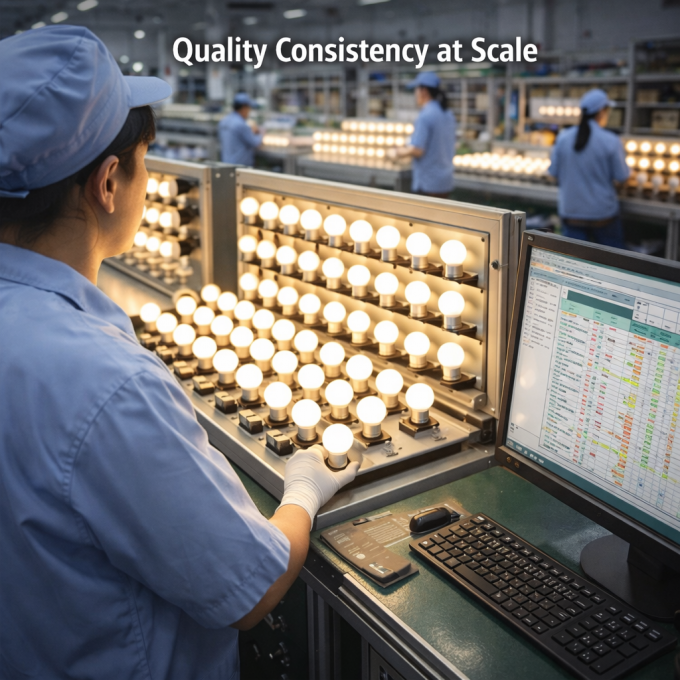
Quality problems rarely appear in the first sample. They emerge when orders scale.
LED bulbs are mass-installed, visually comparable, and electrically sensitive. Small variation becomes obvious quickly.
Why bulbs expose inconsistency
Typical symptoms include:
These issues damage brand trust and distributor confidence.
Sources of batch variation
Variation usually comes from:
Supply chains differ in how aggressively they prevent these changes.
Process-driven versus adjustment-driven quality
Process-driven regions emphasize:
Adjustment-driven regions rely more on:
- inspection after change
-
correction after failure
Prevention performs better at scale than correction.
Scale amplifies small decisions
A 0.5% defect rate appears minor.
At scale:
Returns, replacements, and reputation cost follow.
Documentation and traceability
Stable supply chains usually maintain:
- batch traceability
-
component history
-
aging and test records
This allows fast root-cause analysis.
In less structured environments, problems are harder to resolve conclusively.
Long-Term Cost Implications for Buyers
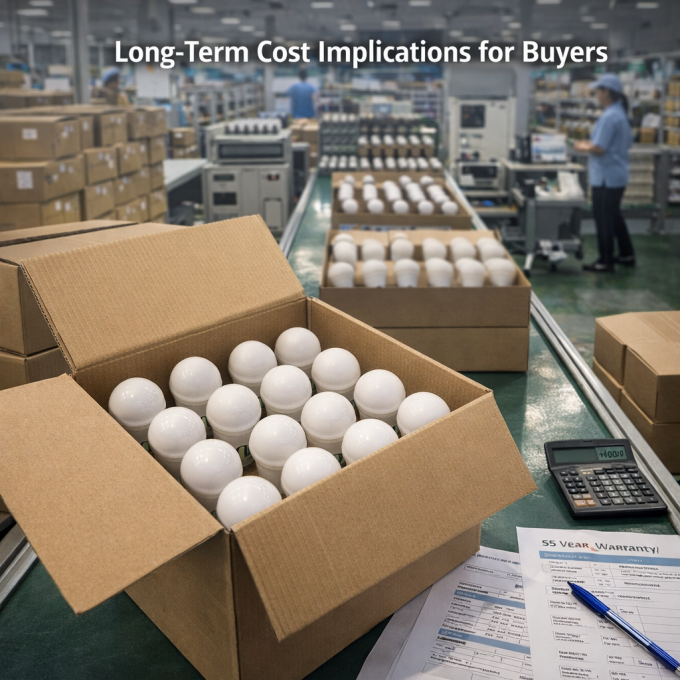
The real cost of LED bulbs is revealed over time, not on the invoice.
Stable supply chains reduce operational friction. Flexible supply chains shift more responsibility onto the buyer.
Hidden long-term costs
Common overlooked costs include:
- re-certification
-
internal QC labor
-
inventory write-offs
-
customer complaints
-
warranty replacements
These costs rarely appear in the quoted price.
Cost behavior over product life
In unstable supply chains, buyers often encounter:
Each change triggers internal cost.
Stable supply chains reduce the frequency of these events.
Brand and reputation impact
For wholesalers and brand owners:
Recovering trust costs more than saving cents per unit.
Inventory and cash flow pressure
Unstable lead times force buyers to:
- hold higher safety stock
-
delay launches
-
lock cash in inventory
Predictable supply chains reduce these pressures.
When flexibility still makes sense
Flexible supply chains remain valuable when:
For standardized LED bulbs, continuity usually delivers lower total cost.
Conclusion
Regional supply chains shape LED bulb cost behavior, lead time reliability, and quality consistency. Stability-oriented regions favor predictability and long-term value, while flexibility-oriented regions trade consistency for speed.
For standardized LED bulbs, long-term performance depends less on quoted price and more on how the supply chain behaves over time.
Teco supports global B2B buyers sourcing GU10, MR16, and A60 LED bulbs with a focus on long-term cost stability, reliable lead times, and consistent quality.
Our manufacturing base operates in Zhejiang, where supply chain structure prioritizes:
If you are evaluating LED bulb suppliers and want to understand not just price, but supply chain behavior:
Email: [email protected]
Website: www.tecolite.com
Tell us your order volume, target market, and growth horizon.
We help buyers choose supply chains that remain stable after the first order—not just competitive on it.


 Your message must be between 20-3,000 characters!