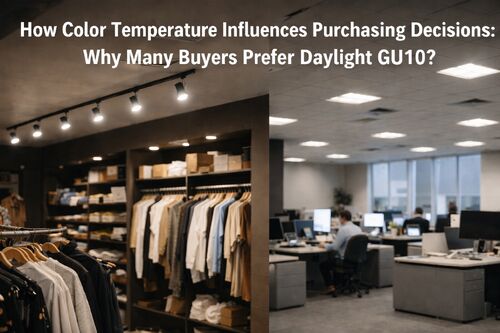
Many GU10 purchasing decisions are described as “technical.” In reality, most of them are psychological, operational, and risk-driven. Buyers do not always choose what designers prefer. They choose what feels safer to sell, specify, and repeat.
Daylight GU10 bulbs are often selected not because they are visually ideal, but because they reduce decision risk, complaints, and downstream uncertainty for buyers.
This article explains how color temperature shapes purchasing behavior, why Daylight GU10 (typically around 4000K in European markets) has become a default choice for many buyers, how commercial and project demand reinforces this preference, and what buyers should evaluate before committing inventory to daylight GU10 bulbs.
How Color Temperature Directly Influences Buying Behavior?
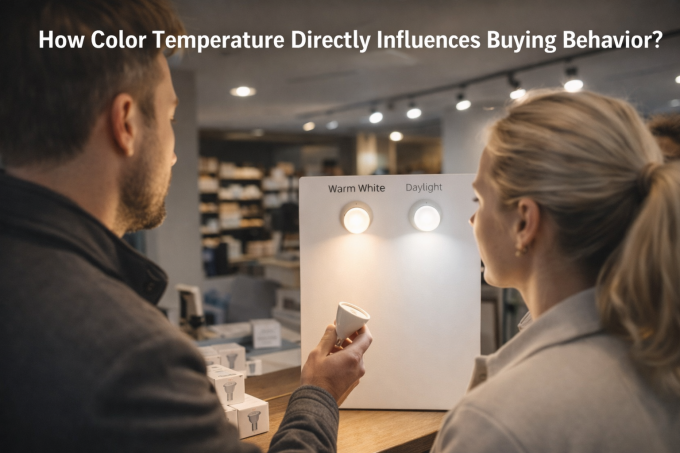
Color temperature is not just a lighting parameter. It functions as a buying signal.
Color temperature purchasing decisions in lighting are driven more by perceived safety, versatility, and complaint risk than by aesthetics alone.
Buyers do not evaluate color temperature like designers
Designers tend to think in terms of:
- mood
-
atmosphere
-
emotional warmth
Buyers, however, think in terms of:
- return rates
-
customer complaints
-
reorders
-
internal approval risk
This difference explains why technically “better” lighting is not always commercially preferred.
Warm light feels subjective, daylight feels neutral
Warm white lighting often triggers subjective reactions:
- “too yellow”
-
“too dim”
-
“feels old-fashioned”
These reactions vary significantly between individuals.
Daylight and neutral white lighting, by contrast, provoke fewer emotional responses. They feel more “correct,” more neutral, and easier to accept without discussion.
Neutrality reduces friction in sales and specification
Daylight GU10 bulbs tend to:
This neutrality directly affects purchasing behavior, especially for bulk buyers and distributors.
Fewer variables mean fewer problems
From a buyer’s perspective, daylight GU10 works in:
Warm white often requires justification.
Justification slows decisions.
Psychological safety in organizational purchasing
In many organizations, daylight GU10 reduces internal debate. It is harder for stakeholders to criticize later, which lowers perceived decision risk for procurement teams.
This is a risk-reduction choice, not a design-driven one.
Why Daylight GU10 Is Perceived as the Safest Choice?
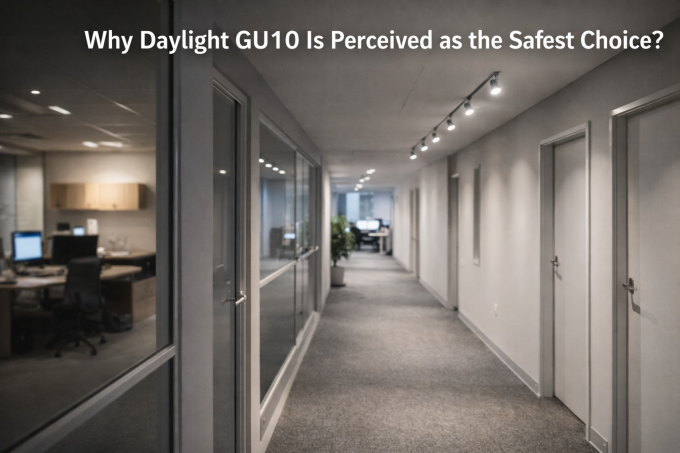
Safety in purchasing is not only about electrical compliance. It is about avoiding problems after delivery.
Daylight GU10 bulbs are perceived as the safest option because they minimize subjective dissatisfaction across different users and environments.
Daylight equals “working light” in buyer logic
In many markets, daylight or neutral white lighting is associated with:
- clarity
-
productivity
-
cleanliness
Even in residential settings, 4000K is often described as “normal” or “clear.”
Perception matters more than theory.
Fewer “too warm” complaints
Warm white GU10 bulbs frequently generate feedback such as:
- “too yellow”
-
“too dark”
-
“not modern enough”
Daylight GU10 rarely triggers strong negative reactions, even when users do not love the appearance.
Daylight travels better across markets
Buyers serving multiple regions face cultural variation.
What feels cozy in one country feels dull or outdated in another.
Daylight GU10 crosses borders more easily with fewer objections, which explains why many buyers default to it as a core SKU.
Operational safety in projects
In project environments, safety means:
Daylight GU10 lowers the chance that someone will say, “This looks wrong.”
Buyer logic summary
Daylight GU10 is chosen because it:
That makes it commercially safe.
Commercial and Project Applications Drive Daylight GU10 Demand
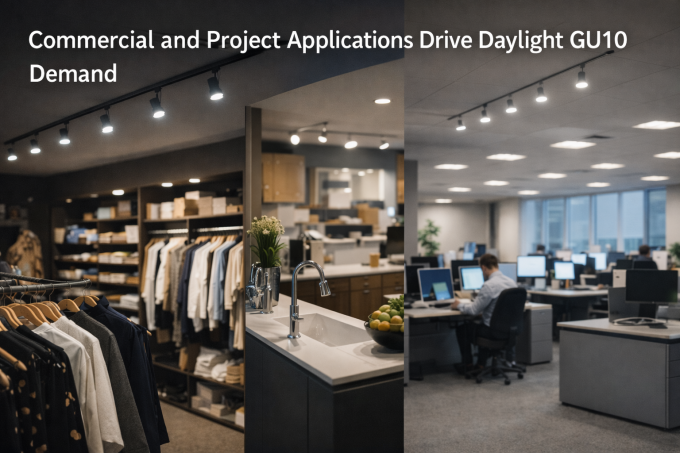
The strongest driver behind daylight GU10 demand is commercial reality, not residential taste.
Daylight GU10 dominates commercial lighting because projects prioritize clarity, consistency, and risk avoidance over atmosphere.
Commercial lighting priorities
Commercial buyers prioritize:
- brightness perception
-
visual clarity
-
standardization
Daylight GU10 supports all three.
Retail and showroom environments
In retail, daylight GU10 bulbs:
- present products clearly
-
reduce color distortion
-
feel modern and clean
Retailers avoid lighting that alters product appearance. Daylight feels safer.
Offices and workspaces
In offices, 4000K is widely perceived as:
Even when circadian discussions arise, buyers often default to daylight GU10 for simplicity.
Hospitality public areas
While guest rooms may favor warmer tones, public areas often use daylight or neutral white because:
Daylight GU10 provides flexibility.
Project-driven stocking behavior
Wholesalers serving project clients stock more daylight GU10 because:
This demand reinforces availability and further normalizes daylight GU10.
Daylight GU10 vs Warm White GU10: Sales Reality vs Design Theory
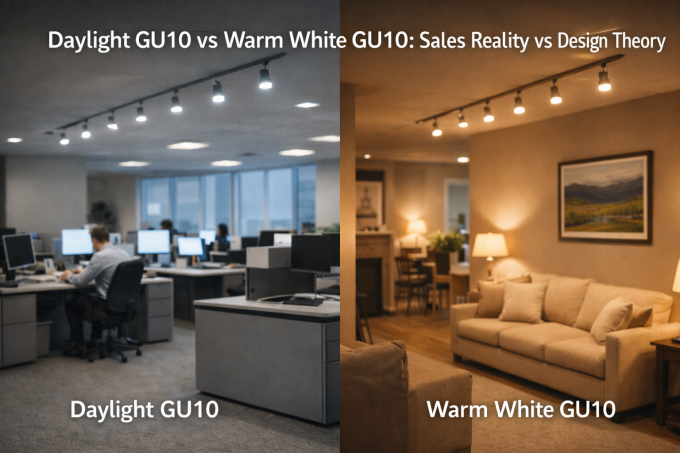
Design theory and sales reality often point in different directions.
The daylight GU10 vs warm white GU10 debate highlights the gap between ideal design and commercial decision-making.
What design theory emphasizes
Design theory often recommends:
This works well in controlled environments.
What sales reality shows
In practice:
Buyers respond to what moves smoothly through the channel.
Inventory risk comparison
| Aspect |
Daylight GU10 |
Warm White GU10 |
| Sell-through speed |
High |
Variable |
| Complaint risk |
Low |
Higher |
| Project acceptance |
High |
Conditional |
| Cross-market use |
Strong |
Limited |
Why reality wins
Sales reality involves:
- mixed expectations
-
rushed decisions
-
non-technical end users
Daylight GU10 performs better under imperfect conditions.
When Daylight GU10 Is the Right Choice—and When It Is Not
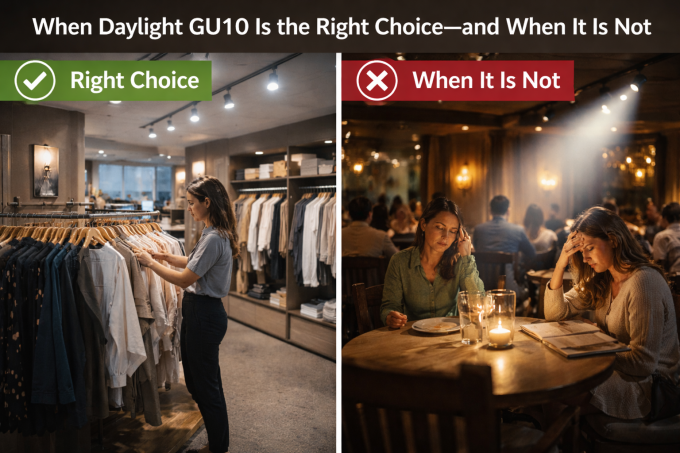
Daylight GU10 is not universally correct.
It works best where clarity and neutrality matter more than atmosphere.
When daylight GU10 is the right choice
- offices
-
retail spaces
-
showrooms
-
corridors
-
kitchens
-
commercial renovations
Where daylight GU10 is often misused
-
bedrooms
-
restaurants
-
lounges
-
hospitality guest rooms
In these spaces, daylight can feel harsh or uncomfortable.
Why buyers still choose it
Buyers often accept this compromise because daylight GU10:
This is a trade-off, not ignorance.
Balanced stocking strategy
Many professional buyers:
This balances risk and experience.
What Buyers Should Evaluate Before Stocking Daylight GU10
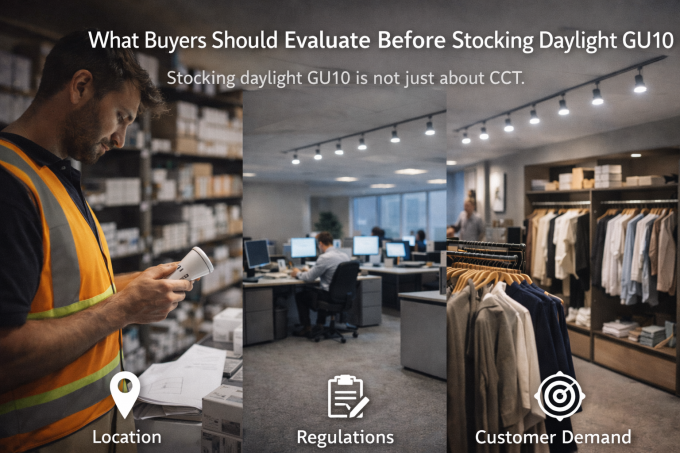
Stocking daylight GU10 is not just about CCT.
Buyers should evaluate consistency, perception, and application fit.
CCT consistency
Daylight GU10 requires tight binning.
Inconsistent 4000K looks worse than inconsistent warm white.
CRI and comfort
Low-CRI daylight lighting can feel:
- flat
-
clinical
-
uncomfortable
Ensure CRI aligns with the target market.
Dimming behavior
Daylight GU10 often performs worse when dimmed.
Check:
- flicker
-
low-end stability
-
dimmer compatibility
SKU positioning
Decide whether daylight GU10 is:
Clear positioning reduces mismatch.
Conclusion
Daylight GU10 bulbs dominate purchasing decisions because they reduce risk, simplify sales, and align with commercial and project-driven demand—even when design theory suggests warmer alternatives.
Teco supports B2B buyers supplying Daylight GU10 bulbs for commercial, residential, and project markets with a focus on consistency, stability, and repeatability.
We help with:
- daylight GU10 vs warm white GU10 SKU planning
-
stable 4000K GU10 production programs
-
private-label and ODM GU10 solutions
-
application-focused specification support
Our goal is not to push one color temperature, but to help buyers stock what actually sells with the least friction.
Email: [email protected]
Website: www.tecolite.com
Tell us your target market and application mix.
We will help you decide whether daylight GU10 should sit at the core of your product line.


 Your message must be between 20-3,000 characters!