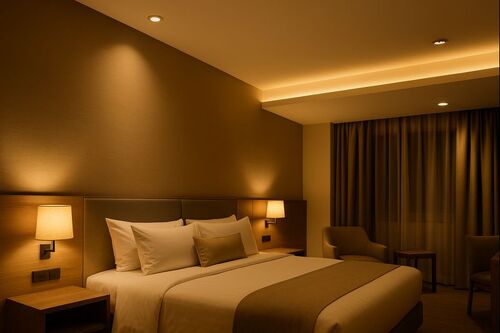
Many lighting projects fail at the wellness stage not because of poor LED quality, but because the wrong spotlight format is selected at the very beginning.
GU10 and MR16 behave fundamentally differently in circadian and wellness lighting applications. The correct choice depends on control accuracy, spectral stability, and how light is delivered to the human eye.
Circadian lighting is not about brightness levels or design trends. It is about biological response. Although GU10 and MR16 may appear similar in size and application, their impact on sleep quality, alertness, and long-term comfort is not the same. This article explains where each format works, where each reaches its limits, and how to choose correctly.
Structural and Electrical Differences Between GU10 and MR16
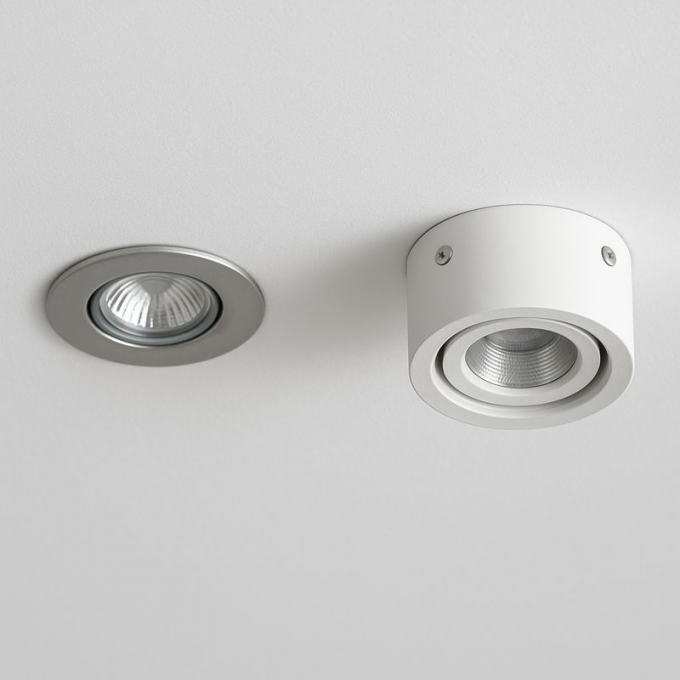
GU10 and MR16 are often compared as interchangeable spotlight formats. Structurally and electrically, they are not.
GU10 is a mains-voltage spotlight with an integrated driver, while MR16 relies on an external low-voltage driver. This difference directly affects stability, control behavior, and biological performance.
Base and voltage structure
| Feature |
GU10 |
MR16 |
| Base type |
Twist-lock |
Bi-pin |
| Operating voltage |
220–240V AC |
12V AC/DC |
| Driver |
Integrated |
External |
| Retrofit ease |
High |
Medium |
| Wiring complexity |
Low |
Higher |
GU10 simplifies installation because the driver is built into the lamp.
MR16 separates the driver, increasing system complexity but enabling greater control flexibility.
Thermal behavior and spectrum stability
Thermal management is critical in circadian and wellness lighting, as temperature variation affects spectral stability.
GU10 lamps often operate at higher internal temperatures due to compact driver integration.
MR16 systems typically run cooler when paired with high-quality remote drivers.
Cooler operation helps preserve:
In wellness-oriented lighting, small spectral deviations can lead to measurable biological effects over time.
Electrical noise and flicker considerations
Low-voltage systems can reduce flicker when properly designed, but poor driver quality can introduce instability.
According to IEEE Std 1789, flicker affects comfort and neurological response, even when it is not consciously visible.
Source: https://ieeexplore.ieee.org/document/6575776
MR16 systems with well-matched drivers often achieve lower flicker levels than GU10.
However, poorly selected transformers can make MR16 systems perform worse than GU10.
Driver quality, not format alone, ultimately determines electrical performance.
Dimming and Control Capabilities
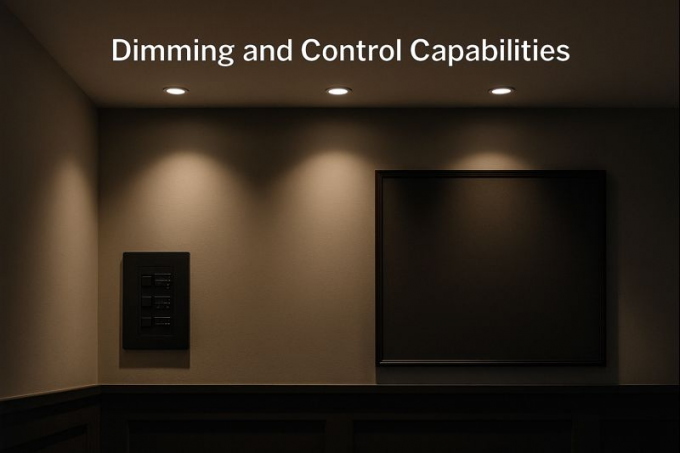
Circadian lighting depends on precise and predictable control. This is where the difference between GU10 and MR16 becomes more pronounced.
MR16 generally offers higher dimming stability and control resolution than GU10, particularly at low light levels.
Dimming and control methods
| Control Method |
GU10 |
MR16 |
| Phase-cut dimming |
Common |
Rare |
| 0–10V |
Rare |
Common |
| DALI |
Very limited |
Widely supported |
| PWM via driver |
Limited |
Flexible |
| Smart system integration |
Moderate |
High |
GU10 relies heavily on phase-cut dimming, a method originally designed for halogen lamps.
While functional, phase-cut dimming offers limited biological precision.
Low-level dimming performance
Circadian and wellness lighting requires:
GU10 often struggles in this range, as integrated drivers can lose regulation at very low current.
MR16 systems with quality external drivers maintain:
This is particularly important in bedrooms, hotels, and healthcare-adjacent environments.
Control logic flexibility
External drivers allow MR16 systems to support:
Most GU10 smart lamps prioritize user convenience rather than biological accuracy.
For circadian lighting, control logic is more important than user interface design.
Circadian and Wellness Lighting Performance
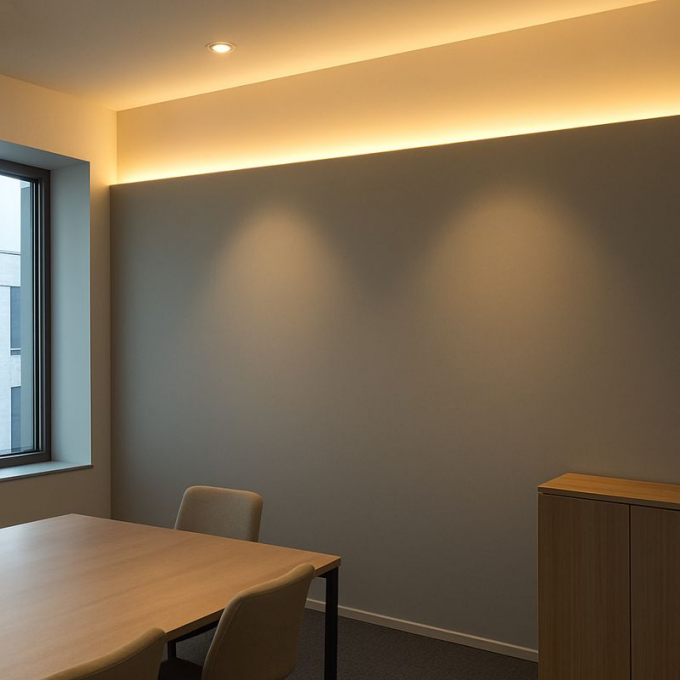
This is the core comparison: biological performance.
MR16 generally delivers more consistent circadian and wellness outcomes due to superior control, spectral stability, and vertical illuminance delivery.
Vertical illuminance at eye level
Circadian response is driven by vertical illuminance reaching the eye, not floor-level lux values.
Source: WELL Building Standard v2
https://standard.wellcertified.com/light
GU10 spotlights typically produce:
MR16 systems are easier to integrate into luminaires that support indirect or diffuse light delivery, enabling more consistent vertical exposure.
Spectrum control and blue light management
White GU10 lamps often retain short-wavelength blue peaks even when dimmed or set to warm CCT values.
MR16 systems can more easily incorporate:
Harvard research confirms that blue light in the 460–480 nm range suppresses melatonin even at low intensities.
Source: https://health.harvard.edu/staying-healthy/blue-light-has-a-dark-side
This makes MR16 systems easier to design for night-time circadian protection.
Flicker and neurological comfort
Flicker contributes to:
- eye fatigue
-
headaches
-
stress response
IEEE research confirms that invisible flicker can still affect the nervous system.
MR16 systems with appropriate drivers consistently achieve lower flicker indices than typical GU10 solutions.
In wellness lighting, consistency is more valuable than installation simplicity.
Application-Based Selection Guidance
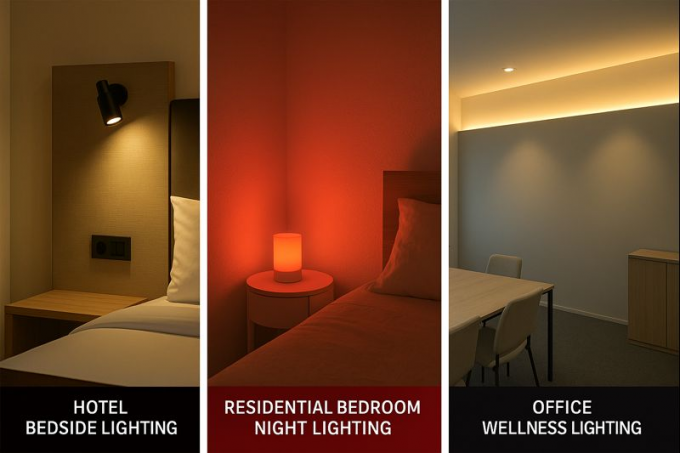
There is no universal winner. The correct format depends on application context.
GU10 is best suited for localized, low-risk circadian support, while MR16 excels in controlled, system-level wellness lighting.
Hospitality guest rooms
| Area |
Preferred Format |
Reason |
| Bedside night lighting |
GU10 (red) |
Simple, safe |
| Bathroom night mode |
GU10 (red) |
Retrofit-friendly |
| Evening ambient lighting |
MR16 |
Better dimming control |
| Morning wake lighting |
MR16 |
Improved vertical exposure |
Hotels often benefit from hybrid solutions that balance guest simplicity with biological performance.
Residential bedrooms
Homes tolerate manual control and variation.
GU10 is acceptable when:
MR16 is better suited for users seeking automation and precision.
Offices and daytime wellness spaces
MR16 is the preferred choice.
Circadian stimulation requires:
- sustained vertical illuminance
-
stable spectrum
-
precise timing
GU10 alone cannot reliably deliver these conditions.
Retrofit projects
GU10 performs best in retrofit environments:
- no rewiring
-
no driver replacement
-
rapid installation
This enables circadian improvement without architectural disruption.
Healthcare and senior living
MR16 is strongly recommended due to:
- lower flicker
-
better spectral control
-
safer low-level dimming
In these environments, circadian disruption has direct health consequences.
Selection Summary and Practical Takeaways
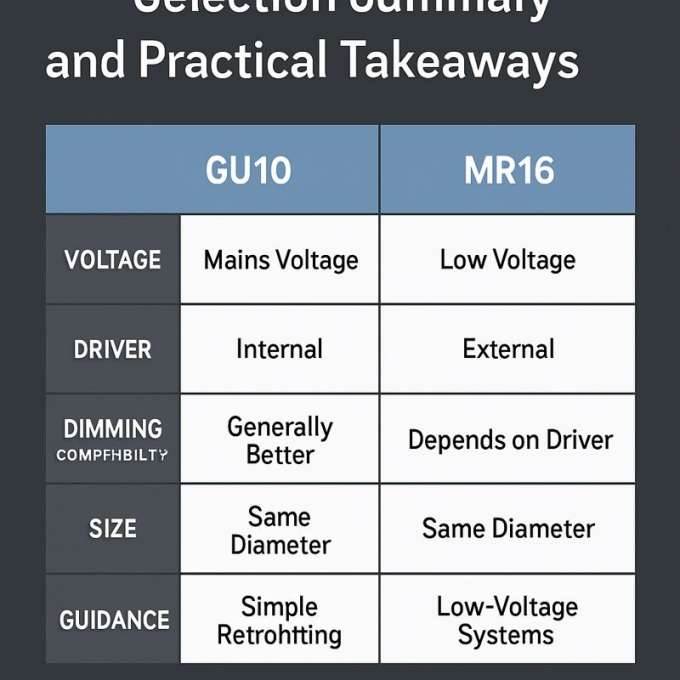
Choosing between GU10 and MR16 is not about which format is superior in general. It is about biological intent.
GU10 offers convenience with clear limitations. MR16 offers precision with higher system demands. Circadian lighting rewards precision.
Practical decision guide
| Priority |
Recommended Format |
| Easy retrofit |
GU10 |
| Night safety lighting |
GU10 (red) |
| Full circadian control |
MR16 |
| Low flicker requirement |
MR16 |
| Budget simplicity |
GU10 |
| Wellness certification targets |
MR16 |
Circadian lighting fails when expectations are misaligned with format capability.
GU10 is not inadequate.
MR16 is not excessive.
Each serves a different biological purpose.
Design should start with biology, not with sockets.
Conclusion
GU10 can support basic circadian use cases, particularly for night-time safety and retrofit scenarios.
MR16 enables stronger, more controllable wellness lighting where biological accuracy and system-level performance are required.
Understanding these boundaries allows designers, engineers, and buyers to avoid misapplication and achieve predictable circadian outcomes.
Teco designs and manufactures GU10 and MR16 LED spotlights for hospitality, residential, and wellness-focused projects, with an emphasis on driver stability, spectral control, and long-term performance consistency.
We support B2B partners with:
- OEM and ODM development
-
warm, amber, and red spectrum options
-
driver and dimming compatibility matching
-
compliance for Europe, the Middle East, and Southeast Asia
If you are evaluating GU10 versus MR16 for a circadian or wellness application, early technical clarification can prevent costly redesigns later.
Email: [email protected]
Website: https://www.tecolite.com
Describe your application requirements.
We will explain what works, what does not, and why.


 Your message must be between 20-3,000 characters!