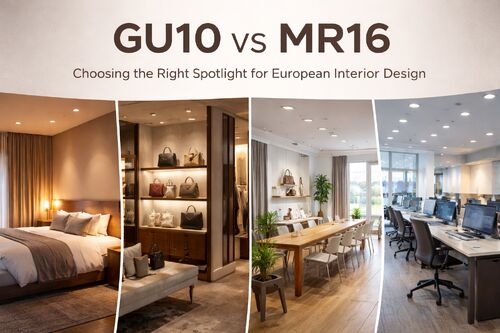
European buyers often compare GU10 and MR16 as if the decision were purely technical. In real projects, especially in hotels, retail, and offices, the choice is driven far more by interior design language, visual texture, and operational risk than by voltage or socket type.
GU10 vs MR16 selection is ultimately about how light feels in a space, how predictable it is at scale, and how well it supports the intended interior design style.
This European lighting buyer guide explains GU10 and MR16 in simple terms, shows how interior design style changes the right choice, and helps buyers decide when MR16 adds value and when GU10 is the safer option for large-scale projects.
GU10 and MR16 Explained Without Technical Language?
Many buyers are put off by technical explanations. The real difference can be understood without electrical jargon.
At a practical level, GU10 and MR16 are two different ways of delivering spotlight lighting, with different visual character and operational behavior.
How GU10 feels in real spaces
GU10 is commonly described as:
In most LED versions, GU10 bulbs integrate the driver inside the lamp. This makes them easy to replace and consistent across fixtures.
For European buyers, GU10 often represents control and simplicity.
How MR16 feels in real spaces
MR16 lighting is often perceived as:
- refined
-
layered
-
visually softer
-
more “designed”
MR16 spotlights typically use an external driver. This allows finer control over current stability and beam shaping.
This difference explains much of the MR16 vs GU10 spotlight difference seen in design-led projects.
What buyers often misunderstand
Buyers often assume:
In reality, both formats exist across premium and commodity ranges. The difference lies in application and intent, not age.
Simple comparison without jargon
| Aspect |
GU10 |
MR16 |
| Installation |
Simple |
More involved |
| Light character |
Clean, direct |
Soft, layered |
| Replacement |
Easy |
Requires driver match |
| Design flexibility |
Moderate |
High |
This is the foundation of GU10 vs MR16 interior design decisions.
How Interior Design Style Determines Whether GU10 or MR16 Works Better?
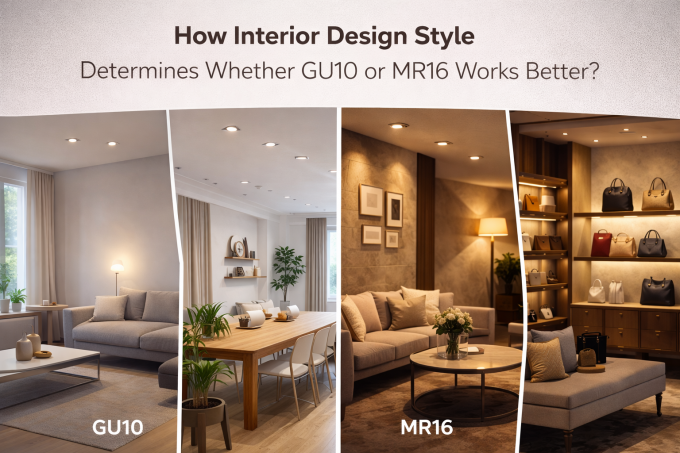
Interior design style defines how light should behave, not just how bright it should be.
GU10 vs MR16 interior design choices depend on whether the space prioritizes clarity and uniformity or depth and texture.
Minimalist and modern interiors
Minimalist interiors value:
- clean lines
-
uniform surfaces
-
visual order
GU10 works well here because:
- light feels neutral
-
shadows are controlled
-
brightness is consistent
In Scandinavian and contemporary European interiors, GU10 aligns naturally with the design language.
Classic and luxury interiors
Classic, luxury, and boutique interiors value:
- depth
-
contrast
-
subtle transitions
MR16 supports this style by:
This is why MR16 is common in high-end hospitality and luxury retail.
Industrial and commercial styles
Industrial spaces often mix:
- exposed materials
-
strong contrasts
-
functional lighting
GU10 is often preferred because:
MR16 may feel too refined for these environments.
Residential-inspired interiors
In residential-style commercial spaces, such as lifestyle hotels or boutique offices, MR16 often feels more “home-like” due to its gentler light texture.
This emotional response is central to GU10 vs MR16 selection.
Design-led takeaway
Interior design defines the light first.
The lamp type should follow the design intent, not the other way around.
Choosing GU10 or MR16 for Hotels, Retail, and Offices in Europe?
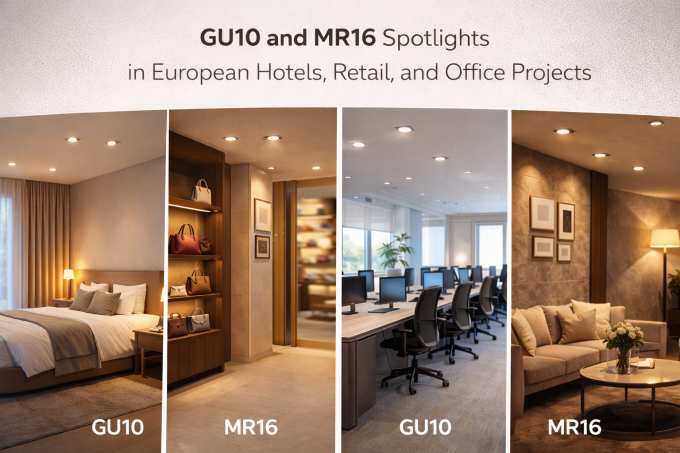
European commercial projects impose different pressures on lighting choices.
GU10 or MR16 for hotel lighting, retail, and offices depends on scale, brand positioning, and operational tolerance.
Hotels and hospitality
In hotels, lighting influences comfort and perception immediately.
High-end hotels accept complexity for visual quality. Mid-scale hotels often prioritize operational simplicity.
This is why GU10 or MR16 for hotel lighting is rarely an all-or-nothing decision.
Retail environments
Retail lighting must sell products.
Retailers often standardize GU10 to reduce downtime, even if MR16 looks slightly better.
Offices and workspaces
European offices focus on:
- visual comfort
-
cost control
-
standardization
GU10 is often chosen because:
MR16 appears mainly in executive areas or feature zones.
European regulatory and operational reality
European projects are sensitive to:
- maintenance cost
-
energy compliance
-
replacement logistics
GU10 aligns well with these pressures, which explains its dominance in large European rollouts.
Application-driven summary
| Application |
Typical Preference |
| Luxury hotel |
MR16 |
| Mid-scale hotel |
Mixed |
| Chain retail |
GU10 |
| Boutique retail |
MR16 |
| Offices |
GU10 |
This table reflects real-world GU10 MR16 application comparison, not theory.
Light Texture Matters: Why MR16 Feels More “Premium” in Certain Spaces?
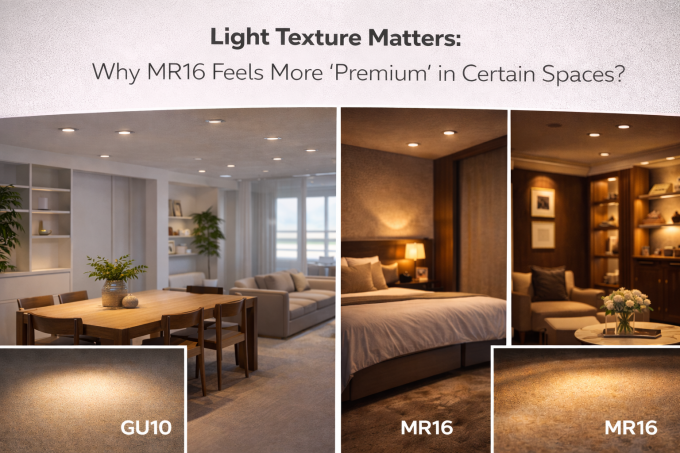
The perception of quality often comes from subtle visual cues.
MR16 often feels more premium because of how it renders surfaces, shadows, and transitions, not because it is brighter.
Beam control and shadow softness
MR16 optics typically deliver:
This reduces harsh contrast and improves visual comfort.
Material interaction
Premium interiors use materials like:
- stone
-
wood
-
textiles
-
matte metals
MR16 light interacts with these materials more softly, enhancing texture.
Visual comfort and dwell time
Studies from the Illuminating Engineering Society (IES) note that controlled luminance and reduced glare improve visual comfort and perceived quality in interior spaces.
Source: https://www.ies.org/standards/
MR16 systems often perform better here due to optical precision.
The cost of premium light
This premium feel comes with trade-offs:
European buyers must decide whether this visual gain justifies the added complexity.
Why premium does not always mean better
In high-traffic or fast-turnover environments, the subtle advantages of MR16 may be lost.
Premium light only matters when people notice it.
Why GU10 Is Often the Safer Choice for Large-Scale European Projects?
Large projects reward predictability more than nuance.
For many European buyers, GU10 vs MR16 selection favors GU10 because it reduces risk across thousands of fixtures.
Replacement and maintenance simplicity
GU10 advantages include:
In large portfolios, these savings compound quickly.
Consistency across batches
GU10 lamps are easier to standardize.
This reduces:
- color variation
-
performance drift
-
mismatch between phases
Consistency is a major concern in European lighting procurement.
Supply chain resilience
GU10 has:
This reduces dependency risk.
Compliance and documentation
GU10 products are often easier to manage in terms of:
- CE documentation
-
energy labeling
-
batch traceability
For large European projects, this administrative simplicity matters.
Buyer psychology at scale
At scale, buyers ask:
GU10 answers these questions more reliably than MR16.
This is why GU10 dominates large European rollouts, even when MR16 looks better in mock-ups.
Practical Decision Guide: Pick GU10 or MR16 in 3 Simple Questions?
Complex comparisons often delay decisions. A simple filter works better.
European buyers can finalize GU10 vs MR16 selection by answering three practical questions.
Question 1: Is visual atmosphere a core brand value?
If light quality defines your brand, MR16 deserves attention.
Question 2: Will this project scale across many locations?
- Yes → GU10
-
No → MR16 or mixed
Scale amplifies maintenance and consistency issues.
Question 3: Who maintains the lighting long-term?
Maintenance reality often decides the outcome.
Mixed strategy is common
Many European buyers adopt:
- MR16 in feature areas
-
GU10 in general areas
This balances design intent and operational safety.
Final decision logic
Do not ask which lamp is “better.”
Ask which lamp fits your design, scale, and risk tolerance.
Conclusion
GU10 vs MR16 selection for European buyers is driven less by technical specifications and more by interior design style, perceived light quality, and operational risk, with MR16 favoring design-led spaces and GU10 offering safer scalability for large projects.
Teco supports European buyers making informed GU10 vs MR16 selection decisions for hotels, retail, and office projects.
We help with:
- GU10 vs MR16 interior design evaluation
-
application-based GU10 MR16 comparison
-
private-label GU10 and MR16 sourcing
-
consistency and compliance planning for Europe
Our focus is not pushing one format, but matching the right light to the right interior and project scale.
Email: [email protected]
Website: www.tecolite.com
Tell us your project type and interior style.
We will help you decide whether GU10, MR16, or a hybrid approach fits your European lighting strategy.


 Your message must be between 20-3,000 characters!