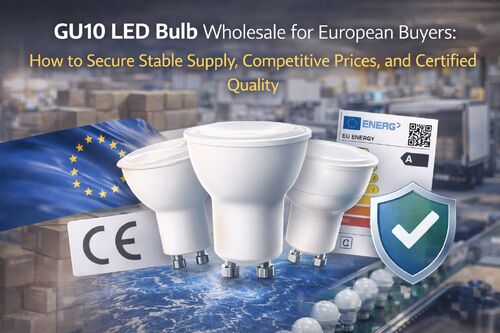
Many European buyers enter GU10 LED bulb wholesale with a simple objective: lower purchase price.
Months later, problems appear—unstable deliveries, inconsistent batches, dimming complaints, or missing compliance documents. At that point, price is no longer the issue.
GU10 LED bulb wholesale in Europe succeeds only when supply stability, sustainable pricing, and EU compliance are managed together as one system—not negotiated separately.
This guide explains how European buyers can build a GU10 LED wholesale sourcing model that survives scale, audits, and long-term market pressure, rather than relying on short-term pricing or supplier promises.
Three Key Targets for EU GU10 Wholesale: Supply, Price, and Compliance
European GU10 wholesale is not a single-variable decision. It is a three-axis balance.
For GU10 LED bulb wholesale in Europe, success depends on achieving stable supply, competitive pricing, and certified compliance at the same time.
Why these three targets cannot be separated
Many buyers attempt to optimize only one factor:
- the lowest unit price
-
the fastest delivery
-
the cheapest certificate
This approach often works for the first order—and fails on the second.
In the EU market:
A professional GU10 LED wholesale supplier for Europe must support all three targets simultaneously.
Target 1: Supply stability
Supply stability means:
It matters far more than short-term speed.
Target 2: Competitive price, not the cheapest price
Wholesale success depends on:
- margin stability
-
long-term cost control
-
predictable landed cost
The cheapest quotation often hides future cost.
Target 3: EU compliance as a baseline, not an option
For European buyers, compliance responsibility does not sit with the factory.
CE, RoHS, and energy labeling are legal obligations of the EU importer.
They are commercial risks, not paperwork details.
The wholesale mindset shift
Successful European buyers stop asking:
“How cheap is this GU10 bulb?”
And start asking:
“How stable is this supply over the next 24 months?”
How to Assess Supply Stability: Capacity, Planning, and Materials

Supply stability is rarely visible in samples. It reveals itself through factory structure.
Stable GU10 LED bulb supply comes from disciplined capacity planning, controlled materials, and production focus—not from promises.
Capacity is more than production lines
When evaluating a factory, buyers should ask:
Factories that treat GU10 as a core category behave very differently from general lighting factories.
Planning discipline
Stable suppliers plan production weeks ahead, not days.
Signs of strong planning include:
Red flags include:
Material control and BOM stability
European buyers should ask directly:
Silent BOM changes are the main cause of:
- CCT drift
-
dimming inconsistency
-
lifetime variation
Professional factories freeze BOMs and require written approval before any change.
Supplier dependency risk
A stable factory maintains:
Factories that frequently change upstream suppliers transfer risk downstream to buyers.
Quick checklist: Supply stability evaluation
- Dedicated GU10 production lines
-
Fixed BOM with change notification process
-
Forecast-based production planning
-
Stable LED chip and driver partners
-
Batch traceability in production
If several of these are missing, long-term stability is unlikely.
How to Secure Competitive Pricing Sustainably: Cost Structure and Negotiation
Competitive pricing is not achieved by pushing quotes down.
It is achieved by structuring cost correctly.
Sustainable GU10 LED bulk pricing depends on cost transparency and long-term negotiation logic—not short-term pressure.
Understanding real GU10 cost structure
A GU10 LED bulb cost typically includes:
| Cost Element |
Risk if Uncontrolled |
| LED chips |
Color and lumen drift |
| Driver |
Flicker and dimming failure |
| Housing |
Thermal instability |
| Labor |
Assembly inconsistency |
| QC and aging |
Early field failure |
| Certification |
Import risk |
| Factory margin |
Supplier survival |
Factories that cut cost blindly usually cut stability first.
Why short-term price pressure backfires
Aggressive price squeezing often leads to:
These changes rarely appear on the invoice.
They appear later as complaints, returns, and warranty claims.
Sustainable pricing strategies for EU buyers
European buyers achieve better long-term pricing by:
Factories reward predictability far more than pressure.
Negotiation questions that work
Instead of asking:
“Can you go lower?”
Ask:
This positions the buyer as a long-term partner rather than a transactional customer.
Private-label advantage
Working with a private-label GU10 LED manufacturer allows buyers to:
This is where ODM pricing consistently outperforms branded products.
EU Compliance Checklist: CE, RoHS, and Energy Label
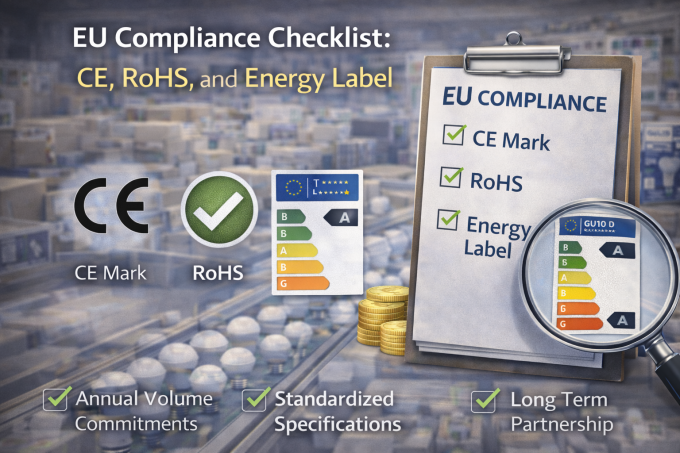
Compliance is not documentation. It is legal responsibility.
Certified GU10 LED bulbs for the EU market must meet CE, RoHS, and energy labeling requirements exactly—not approximately.
CE marking essentials
CE compliance requires:
Buyers should request:
CE marking without traceable reports has no legal value.
RoHS compliance
RoHS controls hazardous substances.
Buyers should require:
A single RoHS failure can block an entire shipment.
Energy labeling and EPREL
EU energy labeling requires:
Incorrect labeling leads to fines, relabeling, or product withdrawal.
Quick compliance verification checklist
- DoC matches exact model number
-
Test reports cover wattage, CCT, and dimming version
-
EPREL registration completed
-
Energy label reflects current EU regulation
If any item is unclear, risk remains with the importer.
Quality Consistency Controls: CCT, Flicker, Lifetime, and Inspection
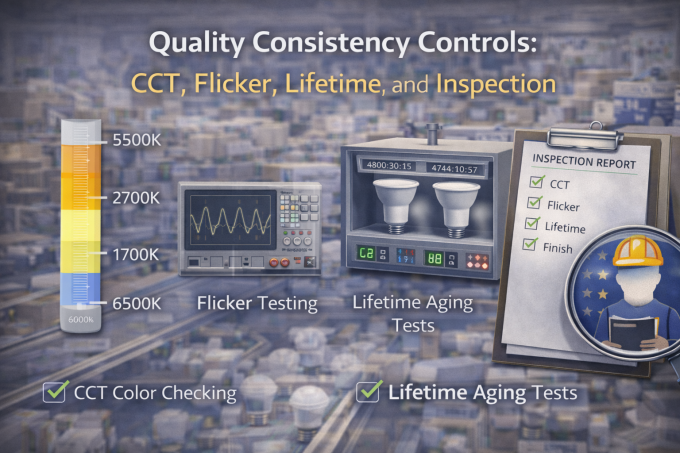
Quality consistency determines whether wholesale scales smoothly or collapses.
GU10 LED bulb wholesale in Europe requires tight control over CCT, flicker, lifetime, and inspection processes.
CCT and color consistency
Buyers should confirm:
Color inconsistency quickly destroys retail and project credibility.
Flicker and driver stability
Flicker causes:
European buyers should require:
Lifetime and thermal management
Lifetime claims depend on structure, not marketing.
Buyers should ask for:
Inspection and traceability
Reliable factories perform:
- incoming material inspection
-
in-process checks
-
aging tests
-
final functional tests
Batch traceability enables accountability and root-cause analysis.
Contract Terms That Lock Risk: Warranty, Compensation, and Lead Time
Contracts convert promises into enforceable behavior.
Strong contracts are essential for stable GU10 LED wholesale in Europe.
Key clauses should define:
Silent changes are one of the biggest wholesale risks.
Best-Practice Model: Primary Supplier + Backup Supplier + Standardized SKUs
Professional European buyers rarely rely on a single factory.
The most resilient GU10 LED wholesale model uses a primary supplier, a qualified backup supplier, and standardized SKUs.
This structure:
Backup suppliers must be pre-tested and contract-ready, not theoretical.
Conclusion
GU10 LED bulb wholesale for European buyers succeeds when supply stability, competitive pricing, and EU-certified quality are deliberately structured—not negotiated reactively.
Teco supports GU10 LED bulb wholesale buyers in Europe with a focus on long-term stability, certified compliance, and predictable pricing.
As a private-label GU10 LED manufacturer, we support:
- stable GU10 LED supply programs
-
CE, RoHS, and EU energy label compliance
-
ODM and private-label projects
-
bulk planning for European markets
Email: [email protected]
Website: www.tecolite.com
If you are evaluating GU10 wholesale sourcing, tell us:
We will help you design a GU10 wholesale supply model that works beyond the first order.


 Your message must be between 20-3,000 characters!