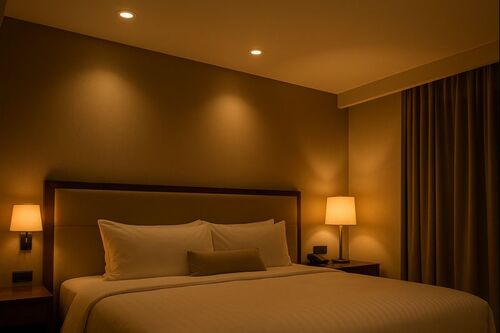
Many lighting projects attempt to implement circadian lighting using GU10 lamps and end up underwhelmed. The concept is often correct, but the execution overlooks fundamental biological and technical constraints.
GU10 lamps can support circadian lighting strategies in specific, well-defined scenarios. They cannot replace full-spectrum architectural circadian systems. Understanding this distinction is essential.
Circadian lighting is not a product category. It is a system logic defined by biological response, control capability, and spatial delivery. GU10 sits within that logic with clear strengths—and equally clear boundaries. This article explains both, without marketing shortcuts.
What Defines a Circadian Lighting System
Circadian lighting is frequently simplified as “changing color temperature.” This is a technical misunderstanding. Visual warmth does not equal biological effectiveness.
A circadian lighting system is defined by how accurately it controls spectrum, timing, intensity, and duration in alignment with human circadian biology.
Core elements of a circadian lighting system
A functional circadian system must address four parameters simultaneously:
| Parameter |
Why It Matters |
| Spectrum |
Determines biological response |
| Intensity |
Sets circadian signal strength |
| Timing |
Aligns with circadian phase |
| Duration |
Sustains biological effect |
If any one of these variables is missing or uncontrolled, the system becomes incomplete.
Many so-called circadian solutions focus solely on correlated color temperature (CCT). This produces visual change but often fails to produce meaningful biological impact.
Biological metrics over visual labels
Modern circadian lighting design relies on non-visual metrics rather than appearance-based descriptions.
| Metric |
What It Measures |
Reference |
| Melanopic EDI |
Biological light effectiveness |
CIE S 026 |
| ipRGC response |
Circadian activation pathway |
Berson et al. |
| CS (Circadian Stimulus) |
Sleep–wake influence |
Rea et al. |
Source: CIE S 026/E:2018
https://cie.co.at/publications/cie-system-metrology-optical-radiation-response-light-non-visual-effects
If a lighting system cannot meaningfully influence these metrics, it should be described as circadian-aware, not circadian-complete.
Where GU10 fits within this definition
GU10 lamps are:
They can participate in circadian strategies, but they cannot independently define circadian outcomes.
Circadian System Types That Can Work with GU10
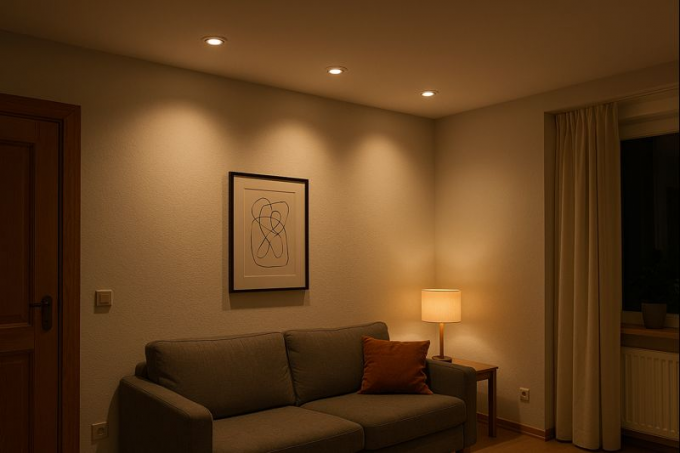
GU10 is not designed for full circadian control. However, it can function within certain circadian system architectures when expectations are realistic.
GU10-compatible circadian strategies rely on discrete spectral stages rather than continuous spectral modulation.
Time-based spectrum staging
This is the most robust and widely applicable approach.
Different GU10 spectra are assigned to specific time periods:
| Time of Day |
GU10 Spectrum |
Purpose |
| Morning |
4000K–5000K |
Support alertness |
| Evening |
2700K–3000K |
Reduce stimulation |
| Night |
Red or amber GU10 |
Protect melatonin |
This method does not attempt to replicate daylight curves. Instead, it respects known biological thresholds—particularly the presence or absence of blue light.
Circadian response is not linear. The human system reacts strongly to spectral boundaries, not smooth transitions.
Dimmable GU10 with controlled scheduling
Dimming can reduce circadian impact, but only under strict conditions:
This approach is most suitable for evening transition phases rather than daytime entrainment.
GU10 as a secondary circadian layer
In well-designed circadian environments, GU10 rarely acts as the primary biological driver.
Instead, it supports:
Primary circadian stimulus is typically delivered through:
GU10 complements these systems. It does not replace them.
Manual circadian zoning
Some residential and hospitality projects deliberately avoid automation.
Typical zoning logic includes:
- primary ceiling lighting disabled at night
-
red GU10 lamps for night navigation
-
warm GU10 for evening ambience
-
daylight GU10 restricted to morning use
This approach is simple, predictable, and aligned with natural human behavior patterns.
Where GU10 Compatibility Reaches Its Limits
GU10 has non-negotiable constraints. Ignoring them leads to ineffective circadian outcomes and user dissatisfaction.
GU10 fails when continuous spectral tuning, high melanopic output, or full-room biological control is required.
Output and spatial coverage limits
Circadian stimulation depends on spatial exposure, not point brightness.
A typical GU10 provides:
- limited luminous flux
-
narrow beam distribution
-
localized illumination
Circadian response is driven primarily by vertical illuminance at eye level, not horizontal lux values.
Source: WELL Building Standard v2
https://standard.wellcertified.com/light
GU10 cannot deliver uniform vertical exposure across a space.
Spectral control limitations
Most GU10 lamps:
Even tunable GU10 lamps often adjust CCT visually rather than melanopically. Visual warmth may improve while biological impact remains largely unchanged.
Why dimming alone is insufficient
A persistent misconception is that dimming white light eliminates circadian disruption.
It does not.
Even low-intensity white light contains blue wavelengths. Research shows that melatonin suppression can occur at very low blue-light exposure levels, including below 10 lux.
Source: Journal of Clinical Endocrinology & Metabolism (2015)
https://academic.oup.com/jcem/article/100/6/2209/2836073
This makes white GU10 unsuitable for true night-time circadian protection.
Control system limitations
GU10-based systems often rely on:
- phase dimming
-
wall-mounted controls
-
limited smart logic
They typically lack:
At scale, this limits reliability for circadian-critical applications.
Expectation boundaries
GU10 cannot:
- replicate outdoor daylight exposure
-
deliver circadian entrainment alone
-
meet healthcare-grade circadian requirements
-
satisfy WELL circadian targets independently
This is not a product failure. It is a design boundary.
Best Use Cases for GU10 in Circadian Strategies
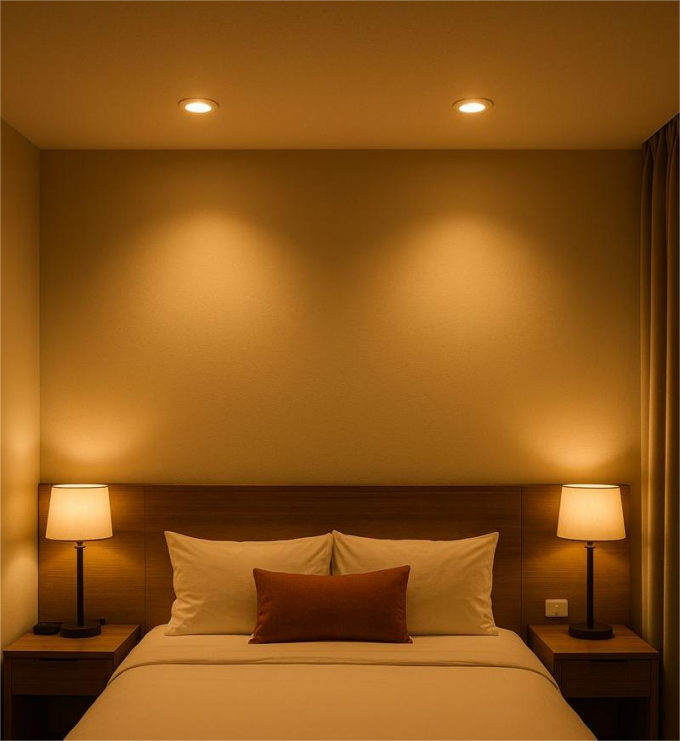
GU10 performs best when applied deliberately rather than aggressively.
Its strength lies in localized, time-specific, and low-risk circadian support.
Hospitality guest rooms
Hotels benefit significantly from GU10 when applied correctly.
| Area |
GU10 Function |
| Bedside |
Warm or red night light |
| Bathroom night mode |
Red GU10 |
| Evening ambience |
2700K, dimmed |
| Morning task |
Limited 4000K |
This approach improves sleep quality without introducing user complexity.
Residential bedrooms
Homes tolerate simpler circadian strategies.
GU10 works well when:
Simplicity often outperforms sophistication.
Retrofit projects
GU10 is particularly valuable in retrofit scenarios:
- no ceiling reconstruction
-
no rewiring
-
minimal disruption
This enables circadian improvement without architectural intervention.
Accent and psychological comfort lighting
Circadian benefit is not purely hormonal.
Warm accent lighting contributes to:
- perceived comfort
-
relaxation
-
emotional safety
These factors indirectly support recovery and sleep quality.
Where GU10 should not be used
Avoid positioning GU10 as:
Correct placement matters more than capability claims.
Conclusion
GU10 lamps can support circadian lighting strategies when applied in time-based, localized, and spectrum-aware roles. They cannot replace full circadian lighting systems.
Used correctly, GU10 enhances comfort, reinforces circadian cues, and enables meaningful improvement—particularly in hospitality, residential, and retrofit-focused projects. Used incorrectly, it creates false expectations and inconsistent outcomes.
Circadian lighting is a system decision. GU10 is one component within that system—not the system itself.
Teco designs and manufactures GU10-compatible dimmable LED spotlights for hospitality, residential, and retrofit-oriented projects, with a focus on stable drivers, controlled spectra, and predictable long-term performance.
We work with B2B partners on:
- circadian-aware GU10 product lines
-
warm, amber, and red spectrum solutions
-
OEM and ODM development
-
compliance for Europe, the Middle East, and Southeast Asia
If you are evaluating whether GU10 is appropriate for a circadian-focused application—or determining where it should not be used—technical clarification at the planning stage can prevent costly misalignment later.
Email: [[email protected]]
Website: [https://www.tecolite.com]
Describe your application goals and constraints.
We will explain what works, what doesn’t, and why.


 Your message must be between 20-3,000 characters!