Color temperature changing GU10 bulbs are frequently marketed as smart, healthy, or even circadian-ready. In real projects, they sometimes add value. In many others, they quietly fail expectations because the technical mechanism behind the color change is misunderstood.
GU10 color temperature changing bulbs primarily adjust visual warmth. Their biological and circadian impact depends entirely on how the color change is achieved, not on the label or the CCT range claimed.
This article explains the actual technical approaches used in GU10 color temperature changing bulbs, how each approach behaves spectrally, where these products are genuinely useful, where they are commonly misapplied, and how they relate—often imperfectly—to circadian lighting strategies. No theory shortcuts. No marketing language.
Technical Types of Color Temperature Change in GU10 Bulbs
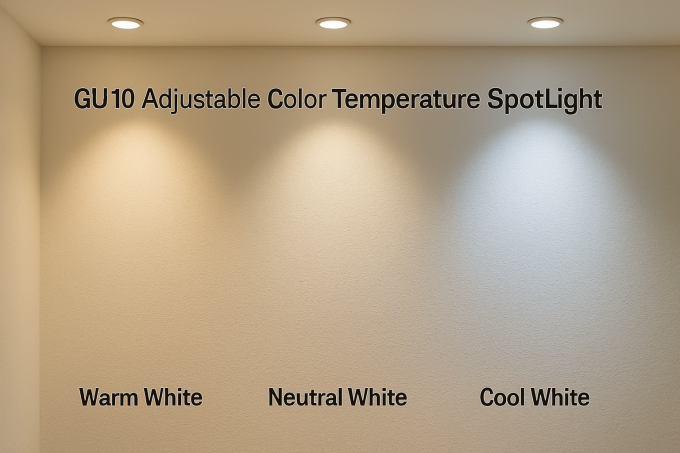
Not all GU10 color temperature changing bulbs work in the same way. The internal method used to change color temperature determines whether the result is merely cosmetic or has any biological relevance.
Understanding the technical category is more important than knowing the advertised CCT range.
Fixed-Step CCT Switching GU10 Bulbs
This is the most common and lowest-cost approach.
The bulb provides two or three preset color temperatures, typically:
Switching is achieved through:
- power cycling
-
wall-switch toggling
-
internal DIP switches
| Feature |
Characteristic |
| CCT change |
Discrete steps |
| Spectrum |
Fixed per step |
| Control |
Manual |
| Cost level |
Low |
Each step activates a separate LED package or phosphor blend. There is no spectral blending and no time-based adaptation.
This approach offers predictability and low flicker risk. It works well in retrofit projects where installers want flexibility without smart controls. However, it does not respond automatically to time of day and provides no biological logic on its own.
Tunable White (Dual-Channel) GU10 Bulbs
Tunable white GU10 bulbs use two LED channels:
- one warm white
-
one cool white
The driver blends these channels at varying current ratios to create a continuous CCT range.
| Feature |
Characteristic |
| CCT range |
Continuous |
| Spectrum |
Mixed |
| Control |
Dimming or smart systems |
| Cost level |
Medium |
Visually, this produces smooth transitions and broad flexibility. Biologically, performance is inconsistent.
In many designs, the cool channel never fully disengages. Even at warm settings, residual blue energy remains in the spectrum. Without published spectral power distribution (SPD) data, biological performance cannot be assumed.
Dim-to-Warm GU10 Bulbs
Dim-to-warm GU10 bulbs are designed to mimic halogen behavior.
As the lamp is dimmed:
| Feature |
Characteristic |
| Trigger |
Dimming |
| Behavior |
Automatic |
| User effort |
Minimal |
| Cost level |
Medium |
Dim-to-warm improves evening comfort and reduces alertness. However, it reduces blue content rather than eliminating it.
This distinction matters. Dim-to-warm supports evening transition but should not be treated as biologically neutral night lighting.
Smart RGBW / RGBWW GU10 Bulbs
These products use multiple LED channels, typically:
- RGB
-
warm white
-
sometimes cool white
They can produce a wide range of colors and color temperatures.
| Feature |
Characteristic |
| Flexibility |
Very high |
| Control |
App-based |
| Complexity |
High |
| Output consistency |
Variable |
These bulbs are designed for visual effects and user interaction, not for biological accuracy. Channel calibration, thermal drift, and driver limitations often lead to inconsistent spectral output, especially at low brightness.
They are suitable for mood lighting. They are unreliable for wellness or circadian objectives.
Why This Classification Matters
Two GU10 bulbs labeled “CCT adjustable” may behave completely differently in real environments.
If the technical method is unclear, biological benefit should be assumed to be limited.
Internal Mechanisms and Their Practical Limits
Color temperature change in GU10 bulbs is determined by LED channel architecture and driver behavior. These constraints define what the bulb can and cannot achieve biologically.
Fixed-Step Mechanisms
Each CCT step activates a dedicated LED package. Output is stable, predictable, and repeatable.
Advantages include:
Limitations are equally clear:
Tunable White Blending Behavior
Dual-channel blending adjusts visual appearance but often fails to remove blue peaks completely.
This leads to a common project issue: a light that looks warm but still suppresses melatonin.
Without SPD data, this failure is invisible until users experience sleep disruption.
Dim-to-Warm Driver Behavior
Dim-to-warm relies on current-dependent spectral shifts.
As current drops:
This improves evening comfort but does not guarantee night-time biological neutrality.
Dim-to-warm is transition-friendly, not night-safe.
Smart GU10 Driver Constraints
Smart GU10 bulbs face hard physical limits:
As a result:
These issues are acceptable in decorative lighting. They introduce risk in wellness-focused projects.
Driver Quality as the Decisive Factor
Regardless of category, the driver determines:
- flicker performance
-
dimming stability
-
spectral consistency
IEEE Std 1789 confirms that flicker affects neurological comfort even when not consciously visible. Low-quality drivers undermine even well-designed LED packages.
Appropriate Use Cases and Common Misuse Scenarios
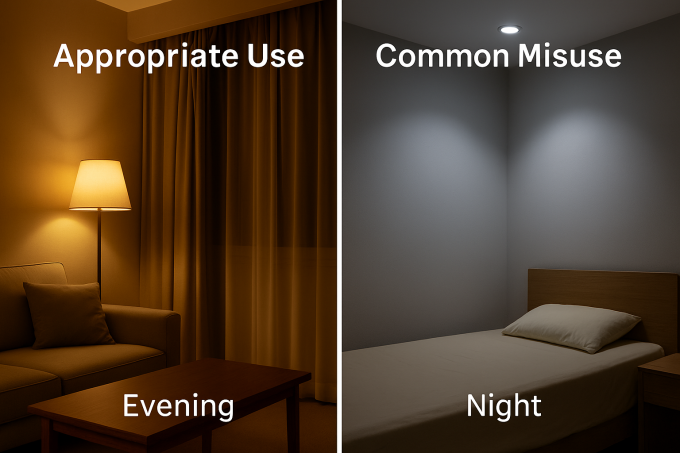
Color temperature changing GU10 bulbs are not inherently problematic. Misuse occurs when expectations exceed what the technology can deliver.
Valid Applications
Evening flexibility in residential spaces
Fixed-step and dim-to-warm GU10 bulbs work well in living rooms and dining areas, allowing users to shift from neutral activity lighting to warmer relaxation light.
Hospitality guest rooms (limited scope)
Hotels benefit from preset warm evening modes and neutral cleaning modes. Fixed-step GU10 bulbs allow staff-controlled defaults without guest education.
Retail and display lighting
CCT adjustment supports visual presentation without biological expectations.
Common Misuse Patterns
Night-time bedroom lighting
Warm white light is often assumed to be safe. It is not always. Even 2700K white light contains blue wavelengths that can suppress melatonin.
Claiming circadian functionality
If a bulb cannot eliminate blue light at night, follow time-based logic, or support vertical eye-level exposure, it should not be labeled circadian.
Over-reliance on apps
Smart GU10 bulbs assume consistent user behavior. In reality, automation is overridden, schedules drift, and systems revert to white light.
Misuse Consequences
| Misuse |
Project Outcome |
| Night use of white light |
Sleep disruption |
| Assuming dimming is enough |
Melatonin suppression |
| Trusting CCT labels |
False wellness claims |
| Ignoring driver quality |
Flicker complaints and instability |
The failure is rarely the bulb itself. It is the expectation.
Relationship to Circadian Lighting Strategies
Color temperature change is frequently confused with circadian lighting. They overlap, but they are not equivalent.
Changing CCT addresses visual comfort. Circadian lighting requires spectrum control, timing, intensity, and exposure geometry.
What Circadian Lighting Requires
| Factor |
Importance |
| Spectrum |
High |
| Timing |
High |
| Intensity |
Medium |
| Duration |
Medium |
| Vertical exposure |
High |
CCT change addresses only one variable.
Where CCT-Changing GU10 Bulbs Fit
These products can support circadian-aware strategies by:
They cannot provide:
Honest Positioning
A realistic statement is:
“GU10 color temperature changing bulbs improve visual comfort and support circadian-aware transitions, but they do not replace circadian lighting systems.”
This framing avoids project disappointment and client conflict.
Conclusion
GU10 color temperature changing bulbs adjust visual warmth using different technical mechanisms. They perform best when used for comfort and transitional lighting, not as substitutes for circadian or biologically precise lighting systems.
Understanding how the color change is achieved is essential to knowing where the product truly fits.
Teco manufactures GU10 LED spotlights, including fixed-CCT, dim-to-warm, and spectrum-specific solutions designed for practical applications in hospitality and residential projects. We work B2B only, focusing on stable quality, clear technical limits, and honest product positioning.
Our factory in China operates four production lines and supports:
- warm, amber, and red GU10 options
-
dim-to-warm GU10 development
-
OEM and ODM customization
-
compliance for Europe, the Middle East, and Southeast Asia
If you are considering GU10 color temperature changing bulbs for a project:
Email: [email protected]
Website: www.tecolite.com
Tell us your application and expectations.
We will help you choose what fits—and avoid what does not.


 Your message must be between 20-3,000 characters!