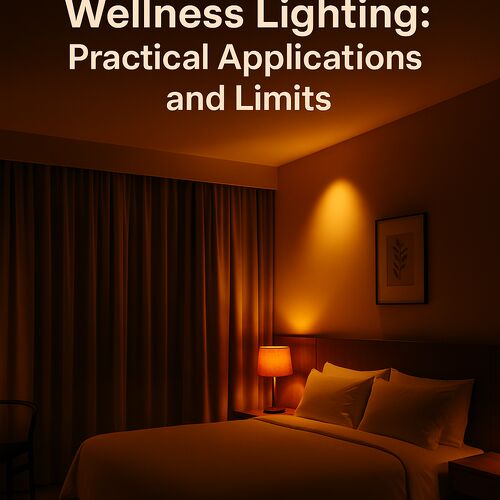
Wellness lighting is often presented as a universal upgrade, yet many projects fail because the selected light format cannot support biological goals. GU10 bulbs are frequently involved in these failures—not because they are poor products, but because their limits are misunderstood.
GU10 bulbs can support wellness lighting in specific, controlled scenarios, but they cannot function as primary biological lighting systems.
Respecting these limits is essential for achieving real wellness outcomes.
Wellness lighting is not about atmosphere alone. It is about how light interacts with hormones, sleep regulation, alertness, and long-term neurological comfort. GU10 bulbs can play a role, but only when used with correct expectations and disciplined design logic.
Fundamental Principles of Wellness Lighting
Wellness lighting is often described emotionally. In practice, it is physiological.
Wellness lighting aims to reduce biological stress and support natural rhythms by controlling spectrum, timing, intensity, and stability of light exposure.
What wellness lighting actually targets
Wellness lighting focuses primarily on non-visual outcomes.
| Target Area |
Why It Matters |
| Sleep quality |
Physical recovery and immune health |
| Alertness regulation |
Cognitive performance and focus |
| Stress modulation |
Hormonal balance |
| Visual comfort |
Eye strain reduction |
| Neurological calm |
Long-term wellbeing |
These outcomes are driven by light spectrum, exposure timing, intensity, and consistency, not aesthetics.
Light as a biological signal
The human body processes light as biological information.
Research confirms that intrinsically photosensitive retinal ganglion cells (ipRGCs) respond strongly to short-wavelength blue light and transmit signals directly to the brain’s circadian center, bypassing visual perception.
Source: Berson DM, 2002
https://www.ncbi.nlm.nih.gov/pmc/articles/PMC1573567/
As a result, a light source may appear comfortable while still disrupting sleep or hormonal balance.
Core rules that define wellness lighting
Across residential, hospitality, and healthcare-adjacent environments, several principles remain consistent:
- Blue-rich light supports alertness, not rest
-
Warm or blue-free light supports relaxation
-
Night-time lighting should minimize biological stimulation
-
Flicker and instability increase neurological stress
Wellness lighting prioritizes harm reduction first, before attempting performance enhancement.
Why product selection matters
Control systems cannot correct inappropriate spectra.
If a bulb emits biologically disruptive wavelengths, dimming or scheduling only reduces the degree of harm—it does not eliminate it.
This is why GU10 selection must begin with wellness principles, not convenience or familiarity.
How GU10 Bulbs Can Contribute to Wellness Lighting
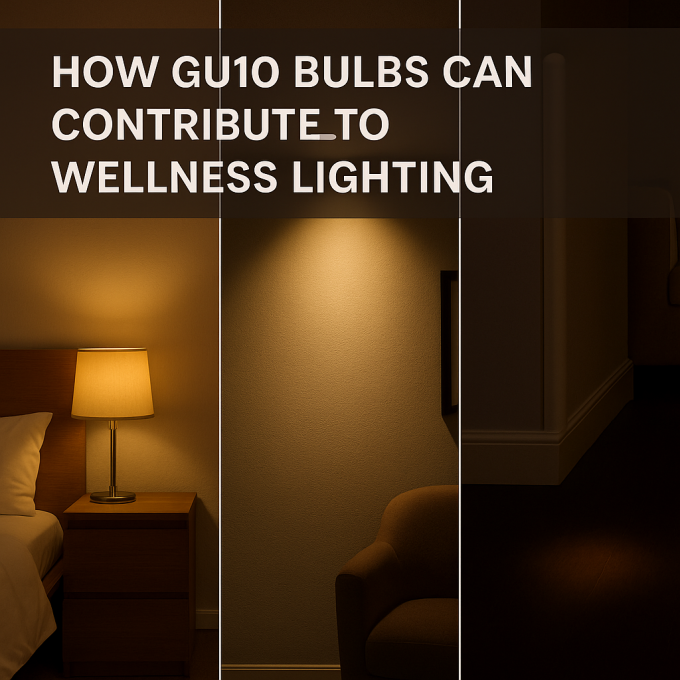
GU10 bulbs are rarely ideal, but they are widely used. Their value lies in limited, well-defined contributions, not comprehensive control.
GU10 bulbs support wellness lighting by enabling localized, low-intensity, spectrum-specific illumination.
Practical strengths of GU10
GU10 bulbs offer several advantages that align with restrained wellness applications:
- easy retrofit
-
low installation cost
-
compact form factor
-
directional control
These characteristics are useful where biological exposure must be controlled rather than amplified.
Localized biological impact
Wellness lighting does not always require room-wide biological stimulation.
GU10 performs well when light should:
Typical examples include:
- bedside lighting
-
accent lighting
-
floor-level navigation
Circadian response depends largely on vertical illuminance at eye level, not floor brightness.
Source: WELL Building Standard v2
https://standard.wellcertified.com/light
Directional GU10 placement helps limit unwanted eye exposure.
Appropriate spectrum use for GU10
GU10 bulbs are most effective when restricted to specific spectral roles.
| Spectrum |
Wellness Function |
| 2700K warm white |
Evening transition |
| Amber |
Late-evening relaxation |
| Red |
Night-time navigation |
White GU10 lamps above 3000K should not be used at night in wellness-oriented environments.
Dimming as a supporting tool, not a solution
Dimming improves comfort only when the spectrum is already biologically appropriate.
A dimmed white GU10 lamp still emits blue wavelengths and can still suppress melatonin.
Harvard Medical School confirms that blue light suppresses melatonin even at low exposure levels.
Source: https://health.harvard.edu/staying-healthy/blue-light-has-a-dark-side
GU10 contributes to wellness when dimming supports safe spectra—not when dimming attempts to compensate for unsafe ones.
Psychological comfort as a secondary benefit
Wellness is not purely hormonal. Emotional perception matters.
Warm GU10 accent lighting can improve:
- perceived comfort
-
relaxation
-
sense of safety
These effects support wellness indirectly, particularly in hospitality environments.
Technical and Biological Limits of GU10 Bulbs
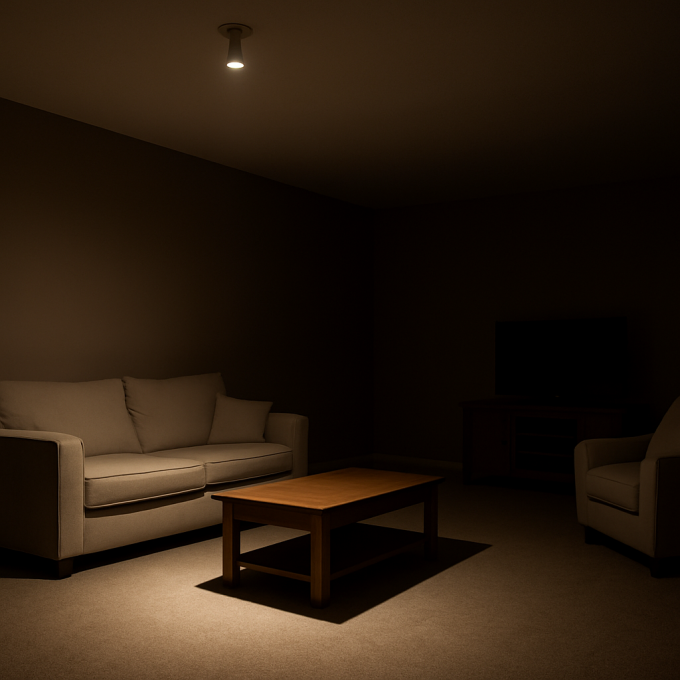
Many wellness projects fail because GU10 bulbs are used beyond their functional boundaries.
GU10 bulbs are not suitable for primary circadian stimulation, large-area wellness lighting, or precision-controlled biological systems.
Output and coverage limitations
Wellness lighting often requires uniform vertical illuminance at eye level.
GU10 bulbs are:
This makes it difficult to deliver consistent biological signals across a space.
Large-area wellness lighting requires:
- diffuse emission
-
indirect distribution
-
broad coverage
GU10 cannot achieve this independently.
Spectrum control constraints
Most GU10 bulbs rely on phosphor-converted white LEDs, which results in:
Even tunable GU10 products often adjust visual appearance without meaningfully reducing melanopic impact.
A visually warmer light may still disrupt sleep.
Misconceptions about low brightness
Low brightness does not equal low biological impact.
Research shows that melatonin suppression can occur at very low blue-light exposure, even below 10 lux.
Source: Journal of Clinical Endocrinology & Metabolism
https://academic.oup.com/jcem/article/100/6/2209/2836073
White GU10 lighting is therefore unsuitable for night-time wellness use, regardless of dimming level.
Flicker and driver variability
GU10 bulbs integrate drivers within compact housings, leading to wide quality variation.
Lower-quality drivers often introduce:
IEEE Std 1789 confirms that flicker negatively affects neurological comfort.
Source: https://ieeexplore.ieee.org/document/6575776
Wellness lighting demands consistency, which GU10 products do not always guarantee.
Certification and system-level limitations
GU10-based solutions rarely meet:
This does not make GU10 unsuitable—it makes it context-limited.
Appropriate Use Cases for GU10 in Wellness Lighting
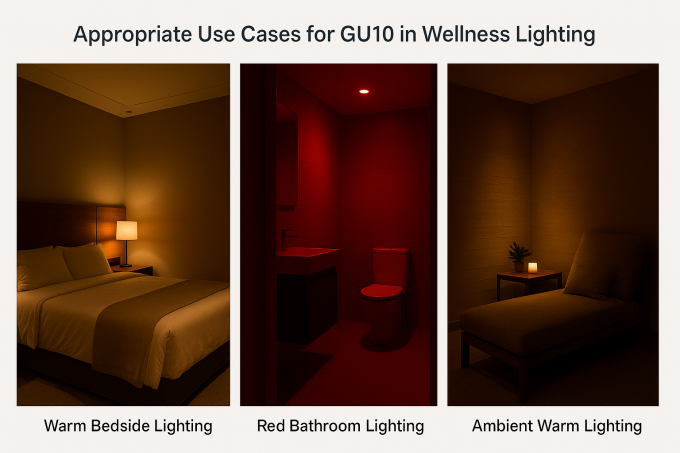
GU10 bulbs perform best when assigned clear, supportive roles within a broader wellness strategy.
Successful projects treat GU10 as a secondary wellness element, not a core biological driver.
Hospitality guest rooms
Small interventions often deliver measurable results.
Effective GU10 deployment includes:
| Area |
GU10 Role |
| Bedside |
Warm or amber light |
| Night navigation |
Red light |
| Bathroom night mode |
Red GU10 |
| Accent lighting |
Warm, indirect |
These changes improve sleep quality without system complexity.
Better sleep correlates with improved guest satisfaction and repeat bookings.
Residential bedrooms
Homes allow greater tolerance for manual behavior.
GU10 works well when:
Simple setups often outperform complex smart systems that users disable.
Wellness hotels and spas
Spas prioritize calm over stimulation.
GU10 is effective for:
- ambient warmth
-
visual comfort
-
psychological relaxation
It should not be used for circadian entrainment or daylight simulation.
Retrofit wellness upgrades
Existing buildings often lack infrastructure flexibility.
GU10 enables:
- low-cost wellness improvements
-
minimal disruption
-
fast implementation
Replacing a limited number of bulbs can significantly improve night-time comfort.
Where GU10 should not be used
GU10 is not appropriate as the primary solution in:
- healthcare facilities
-
senior living circadian programs
-
office environments focused on alertness
-
research-driven wellness installations
These applications require precision GU10 cannot provide.
Conclusion
GU10 bulbs can support wellness lighting when used for localized, low-impact, spectrum-aware applications.
They are not substitutes for architectural circadian systems and should not be treated as such.
Wellness lighting succeeds when biological limits are respected and product roles are clearly defined.
GU10 works best when restraint—not ambition—guides its use.
Teco manufactures GU10 LED spotlights designed for wellness-aware applications, particularly in hospitality and residential retrofit projects.
We work B2B only, focusing on stable quality, verified performance, and realistic application guidance.
Our China-based factory operates four production lines and supports:
- warm, amber, and red GU10 solutions
-
stable low-level dimming
-
OEM and ODM customization
-
compliance for Europe, Middle East, and Southeast Asia
If you are planning a wellness lighting project and considering GU10 bulbs:
Email: [email protected]
Website: www.tecolite.com
Tell us your space and biological goal.
We will tell you honestly where GU10 works—and where it does not.


 Your message must be between 20-3,000 characters!