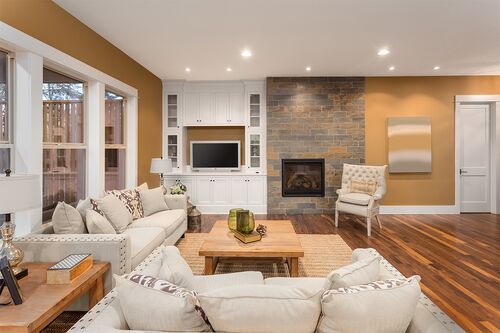
Confused by LED specs? Overwhelmed by choices? Let’s turn jargon into clear, actionable decisions.
Choose LEDs by room function, brightness (lumens), color temperature (CCT 2700–4000K), CRI ≥90, beam angle, dimming compatibility, glare control, efficiency (lm/W), and reliable lifetime data.
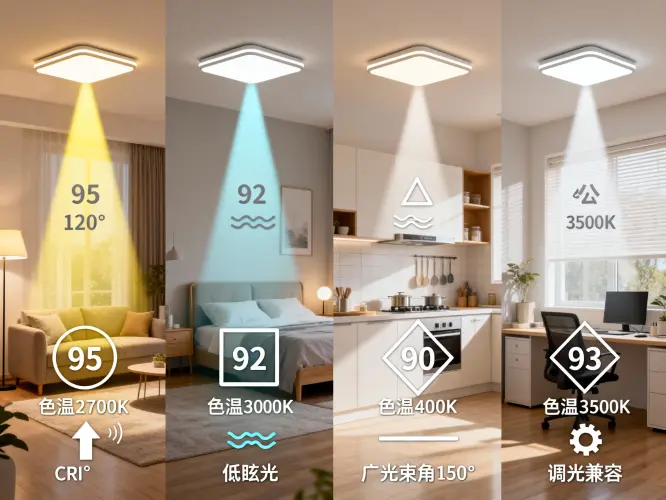
LED lighting home office guide
Below, I’ll break LED selection into simple steps: types, efficiency math, and installation tips—so your spaces look great, feel comfortable, and save money.
Understanding Different Types of LED Lights?
Dizzy from bulbs, panels, strips, and downlights? The wrong pick wrecks comfort and aesthetics.
Match the LED type to the task: general ambient lighting, focused task lighting, or accent lighting. Consider beam angle, CCT, CRI, dimming, and glare (UGR) to balance comfort, performance, and style.
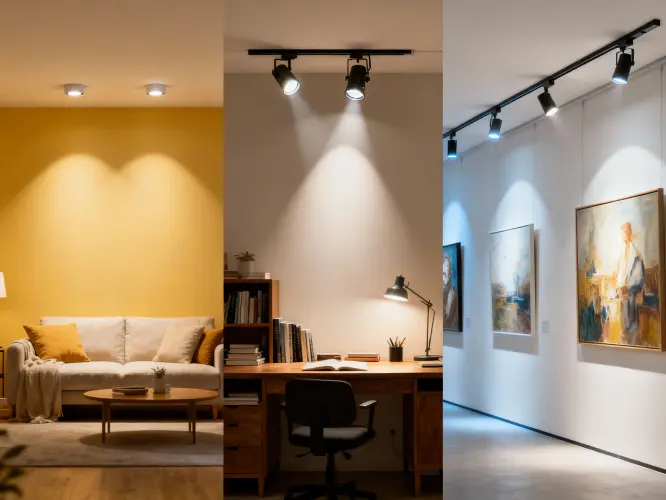
types of LED lights, beam angle, CRI, CCT
Form factors and where they shine
LEDs come as bulbs (A19), downlights, spotlights, panels, tubes, and strips. Bulbs and panels excel at ambient light; spotlights and downlights tame focus and shadows; strips add accent lines under cabinets and shelves. Start by mapping tasks: reading, working, relaxing, showcasing.
Beam angle, CCT, and CRI—comfort trinity
Beam angle controls spread: narrow beams highlight; wide beams bathe rooms. CCT sets mood: 2700–3000K feels warm and cozy for living rooms; 3500–4000K keeps offices alert without harshness. High CRI (≥90) preserves natural colors in kitchens, workstations, and product displays.
Dimming and control protocols
If you want smooth dimming, check compatibility: 0–10V for commercial simplicity; DALI for networked, scene-based control; trailing-edge for many consumer dimmers. Always pair fixtures with the right driver and dimmer to avoid buzz, dropout, and color shift.
Glare and visual comfort
Glare drains focus. Look for low UGR ratings, deep reflectors, prismatic diffusers, and thoughtful placement. In offices, avoid line-of-sight to bright LED dots. In homes, keep spotlights off TV screens and reflective surfaces.
Quick reference table
| LED Type |
Best Use |
Typical Beam |
Recommended CCT |
Pros |
| Bulbs (A19) |
Lamps, general ambient |
220–270° |
2700–3000K |
Easy retrofit, wide spread |
| Downlights |
Living, corridors |
60–100° |
2700–3500K |
Clean ceiling look, low glare |
| Spotlights |
Art, task highlights |
15–40° |
3000–3500K |
Precise accents, punchy beams |
| Panels |
Offices, kitchens |
100–120° |
3500–4000K |
Uniform, low-profile |
| Tubes (T8) |
Garages, basements |
120° |
4000K |
High efficiency, linear spread |
| Strips |
Cabinets, coves |
120° |
2700–3000K |
Flexible, sleek accents |
Energy Efficiency and Cost Savings with LEDs?
Paying too much for light? Old tech wastes power and time.
LEDs cut energy via high lumens-per-watt, long lifespans, and fewer replacements. Calculate savings with wattage, operating hours, and local kWh rates. Check power factor and LM-80/TM-21 data to trust lifetime claims.
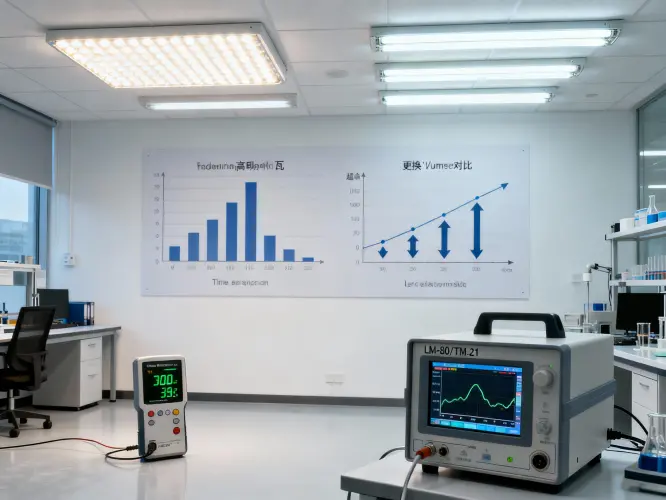
LED energy efficiency, cost savings, lm/W
The efficiency math that matters
Brightness comes from lumens, not watts. Efficiency (lm/W) compares light output to energy use. A 10W LED at 900 lm beats a 60W incandescent at ~800 lm. Multiply watts by hours and by your utility rate to estimate annual cost. Higher lm/W equals lower bills.
Lifetime and maintenance
Beyond energy, lifespan matters. LM-80 tests LED lumen maintenance; TM-21 projects it. Favor products with published data and robust thermal design. Stable drivers, good heat sinking, and high power factor reduce failures and wasted energy, cutting maintenance trips and downtime.
Sample savings table (per fixture)
| Technology |
Brightness (lm) |
Power (W) |
Hours/yr |
kWh/yr |
Cost @ $0.15/kWh |
5-Year Energy Cost |
| Incandescent |
~800 |
60 |
2,000 |
120 |
$18.00 |
$90.00 |
| CFL |
~800 |
13 |
2,000 |
26 |
$3.90 |
$19.50 |
| LED |
~900 |
10 |
2,000 |
20 |
$3.00 |
$15.00 |
ROI tips
Include the purchase price, expected lifetime, and maintenance labor. For offices, scale across fixtures. Prioritize LEDs with honest specifications, high power factor, and credible LM-80/TM-21 reports to lock in predictable savings.
Tips for Installing and Maintaining LED Lighting?
Great specs still fail with poor install. Flicker, glare, and heat can undo everything.
Verify voltage, dimming compatibility, and fixture placement. Manage heat, minimize glare, and maintain clean optics. Monitor flicker and drivers, and schedule proactive replacements to keep performance consistent.
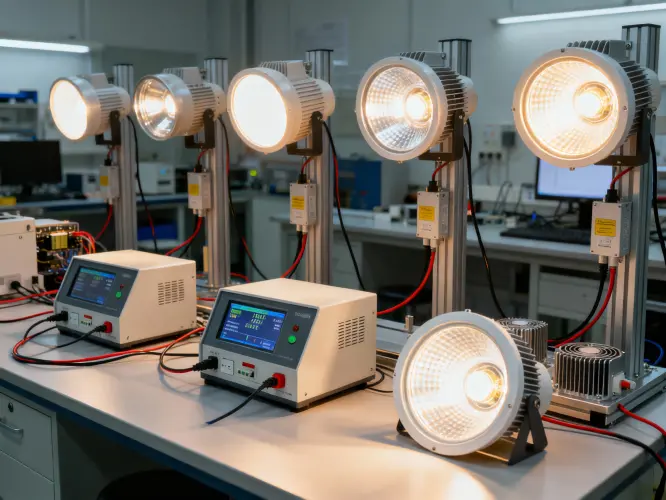
LED installation tips, maintenance, glare, flicker
Installation best practices
- Electrical: Match voltage, check polarity, and confirm dimmer type. Mix-ups cause buzzing or dropouts.
-
Placement: Use wider beams for ambient, tighter beams for tasks. Keep direct lines of sight to bright sources out of view to reduce glare.
-
Height and spacing: Downlights at 0.8–1.2m spacing in typical 2.4–2.7m ceilings; avoid scalloping on walls unless desired.
Thermal and driver care
Heat shortens life. Ensure airflow around fixtures, avoid insulation contact unless IC-rated, and keep drivers ventilated. In enclosed luminaires, derate output or choose models designed for high ambient temperatures. Stable drivers protect LEDs from current ripples that cause flicker and color shift.
Cleaning and performance checks
Dust dims light. Wipe diffusers, lenses, and reflectors gently with lint-free cloths. Periodically check output and color consistency; replace failing units before they cause visual patchiness. In offices, log burn hours and plan group relamping to keep spaces uniform and productive.
Practical checklist
| Task |
Why it matters |
How to do it |
| Verify dimming compatibility |
Prevent flicker/buzz/dropouts |
Match driver to dimmer (0–10V, DALI) |
| Manage heat |
Extend LED/driver lifespan |
Provide airflow; use IC-rated fixtures |
| Control glare |
Comfort, productivity |
Use diffusers, shielding, proper angles |
| Clean optics |
Maintain brightness and CRI |
Gentle, regular dusting |
| Monitor flicker |
Visual comfort and wellness |
Test at various dim levels |
| Plan replacements |
Consistency and uptime |
Track hours; group relamp where needed |
Conclusion
Pick the right LED type, run the efficiency math, and install smart—comfort improves, bills drop, and reliability holds.
Footnotes


 Your message must be between 20-3,000 characters!