Three-way color lamps look simple on the outside. One bulb. Three color temperatures. One switch. In bulk purchasing, however, they are among the easiest LED products to get wrong. Many buyers discover problems only after installation: unstable switching, flicker, color inconsistency between batches, or early failures that are difficult to explain to customers.
LED three-way color lamps bulk purchase is not about buying a clever feature. It is about managing electrical behavior, optical consistency, and supply chain discipline at scale.
This guide explains what LED three-way color lamps really are, how they differ from ordinary LEDs, which quality criteria matter most, how to evaluate switching stability and flicker, why batch consistency is critical, and how professional buyers should approach bulk orders without falling into the “cheapest wins” trap.
What Are LED Three-Way Color Lamps — and Why They Are Not the Same as Ordinary LEDs?
At first glance, three-way color lamps appear similar to standard LED bulbs. Internally, they are far more complex.
LED three-way color lamps are multi-state lighting systems packaged inside a single bulb, not simple single-mode LEDs.
How three-way color lamps actually work
A typical three-way color lamp cycles through different color temperatures, usually via:
- a standard wall switch
-
a pull-chain socket
-
power interruption logic
Each switch action triggers a different internal circuit state.
This requires:
Ordinary LEDs do not require this logic.
Why three-way color lamps are harder to design
Compared to standard LEDs, three-way lamps must manage:
Each added function increases failure risk.
Common misunderstanding among buyers
Many buyers assume:
“If the lamp switches colors, quality is fine.”
In reality, switching function alone says nothing about:
- flicker
-
long-term stability
-
batch consistency
This misunderstanding is the root of many failed bulk order three-way color bulbs programs.
Typical applications
Three-way color lamps are widely used in:
This is why three-way color lighting for commercial spaces demands higher stability than consumer-only products.
Key Quality Criteria for LED Three-Way Color Lamps?
Quality in three-way lamps is multi-dimensional. Buyers must evaluate more than brightness and CCT labels.
LED three-way color lamps quality criteria include electrical stability, optical consistency, control logic reliability, and thermal design.
Electrical and control quality
Key electrical criteria include:
Poor logic design causes random switching or skipped modes.
Optical performance and color accuracy
Each color temperature must be:
- accurately defined
-
visually distinct
-
consistent across lamps
Key optical metrics include:
Color inconsistency is amplified in bulk installations.
Flicker performance
Flicker is one of the most common complaints.
According to IEEE 1789-2015, excessive flicker can cause:
- visual discomfort
-
headaches
-
reduced task performance
Reference:
https://standards.ieee.org/ieee/1789/4961/
High quality LED three-way color bulbs must control flicker at all switch states, not only one.
Thermal design and lifetime
Three-way lamps often pack more components into the same housing.
Thermal risks include:
Thermal design directly affects lifetime.
Key quality checklist
| Quality Area |
What to Check |
| Switching logic |
Stable, repeatable |
| Flicker |
Low at all CCTs |
| CCT accuracy |
Tight tolerance |
| CRI |
Consistent across modes |
| Thermal design |
Adequate heat dissipation |
| Component grade |
Long-life capacitors |
Skipping any of these criteria leads to field problems.
How to Evaluate Switch Stability and Flicker Performance?

Switch stability separates serious products from novelty items.
Evaluating switching stability and flicker is mandatory before any LED three-way color lamps bulk purchase.
Switch stability under real conditions
Switch stability should be tested under:
- rapid on–off cycles
-
varying interval timing
-
voltage fluctuation
Many failures only appear after repeated switching.
Power interruption logic risks
Three-way lamps rely on detecting power-off duration.
Problems occur when:
This leads to:
- skipped modes
-
random color selection
Flicker testing across all modes
Flicker must be measured at:
- low CCT mode
-
mid CCT mode
-
high CCT mode
Some lamps control flicker well in one mode and fail in others.
Reference for flicker measurement principles:
https://www.energy.gov/eere/ssl/flicker
Visual vs measured flicker
Do not rely on visual inspection alone.
Professional buyers should request:
- percent flicker
-
flicker index
-
test methodology
These metrics are defined by IES and IEEE guidelines.
Practical test approach for buyers
Before bulk order three-way color bulbs, buyers should:
Short tests hide long-term issues.
Batch Consistency: Why It Matters and How to Insist on It?
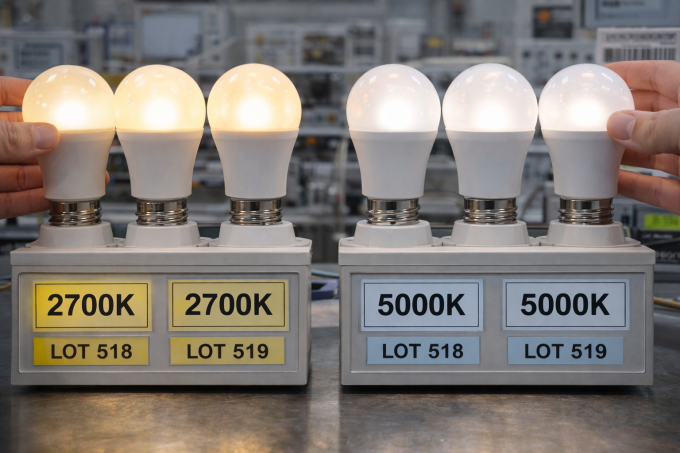
Batch consistency is the biggest hidden risk in three-way lamps.
In LED three-way color lamps bulk purchase, batch inconsistency causes more damage than single-lamp failure.
Why batch consistency is harder for three-way lamps
Each lamp includes:
This increases variation risk.
What inconsistency looks like in the field
Common batch issues include:
Customers notice immediately when lamps are compared side by side.
Causes of batch inconsistency
Typical causes include:
- LED bin changes
-
driver or control IC substitution
-
firmware or logic adjustments
-
cost-driven component changes
Many of these changes are not communicated.
How to insist on consistency
Professional buyers should require:
Batch control tools
Ask suppliers about:
Without these, consistency is not enforceable.
Why consistency matters more in bulk
In small quantities, variation is tolerated.
In bulk, inconsistency becomes:
- a brand problem
-
a project failure
-
a return nightmare
High quality LED three-way color bulbs must be consistent by design.
Supplier and Supply Chain Capability Evaluation?

Three-way color lamps test a supplier’s real capability.
Only suppliers with strong electronic design and process control can support reliable LED three-way color lamps bulk purchase.
What to evaluate beyond price
Buyers should evaluate:
Assembly-only factories struggle with three-way logic.
Supply chain stability
Ask suppliers:
Component volatility leads directly to inconsistency.
Engineering communication
Strong suppliers can explain:
Weak suppliers avoid technical discussion.
Red flags in supplier selection
Warning signs include:
These issues grow worse at scale.
Why supply chain matters more than brand
Brand labels do not control electronics quality.
Supply chain discipline does.
This is why supplier evaluation is central to bulk purchasing.
Cost vs Value: How to Avoid False “Cheapest Wins”?
Three-way lamps often look overpriced compared to standard bulbs. Cheap ones look attractive. Many fail.
In LED three-way color lamps bulk purchase, the cheapest option often creates the highest total cost.
Where cheap three-way lamps cut corners
Low-cost products often sacrifice:
- capacitor quality
-
thermal margin
-
calibration time
-
testing depth
These savings are invisible upfront.
Hidden cost drivers
Hidden costs include:
- returns
-
replacements
-
customer complaints
-
labor for reinstallation
These costs often exceed initial savings.
Value-based cost evaluation
A better evaluation compares:
| Factor |
Cheap Option |
Stable Option |
| Unit price |
Low |
Moderate |
| Failure rate |
High |
Low |
| Consistency |
Variable |
Stable |
| After-sales cost |
High |
Low |
| Brand impact |
Negative |
Neutral |
Long-term procurement reality
For commercial buyers, stability protects:
- contracts
-
reputation
-
repeat business
Value beats lowest price every time.
Cost mindset shift
Do not ask:
“How cheap is this lamp?”
Ask:
“How many problems will this lamp create over two years?”
Practical Steps for Bulk Purchase of LED Three-Way Color Lamps?
A structured process reduces risk.
Successful LED three-way color lamps bulk purchase follows a disciplined, step-by-step approach.
Step 1: Define clear specifications
Define:
- CCT values and sequence
-
brightness balance
-
flicker limits
-
switching logic
Ambiguity leads to inconsistent execution.
Step 2: Request technical documentation
Ask for:
Documentation reveals seriousness.
Step 3: Sample testing under real conditions
Test samples:
- with intended switches
-
across multiple cycles
-
over extended run time
Do not rush this step.
Step 4: Pilot batch before full order
A pilot batch reveals:
- batch consistency
-
packaging quality
-
logistics handling
Skipping this step increases risk.
Step 5: Lock specifications contractually
Include:
Contracts protect both sides.
Step 6: Plan for repeat orders
Ensure:
- component continuity
-
production capacity
-
long-term availability
Bulk purchasing is rarely a one-time event.
Conclusion
LED three-way color lamps are complex products that demand disciplined design, stable supply chains, and strict batch control, and buyers who treat them like ordinary LEDs risk quality failures, inconsistency, and long-term cost escalation.
Teco supports professional buyers with LED three-way color lamps bulk purchase programs designed for stability, consistency, and long-term performance.
We help with:
- defining LED three-way color lamps quality criteria
-
verifying switch stability and flicker performance
-
managing batch consistency across large orders
-
supplying high quality LED three-way color bulbs for commercial use
Our focus is not selling the cheapest product, but delivering lamps that perform reliably at scale.
Email: [email protected]
Website: www.tecolite.com
Share your target application, volume, and switching method.
I will help you evaluate whether a three-way color lamp is truly suitable for your bulk purchase plan.


 Your message must be between 20-3,000 characters!