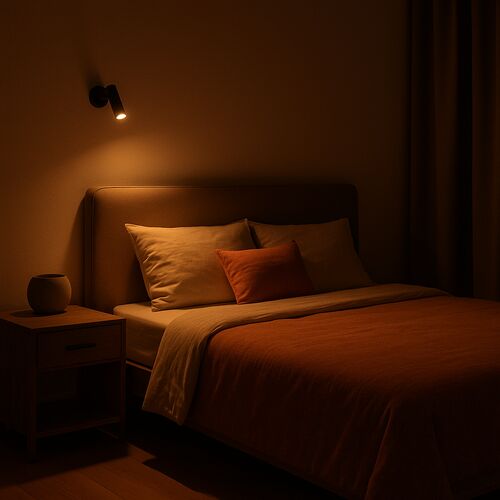
Retrofit lighting projects fail when ambition ignores reality. Budgets are fixed, ceilings remain closed, and operational downtime is not negotiable. In this context, circadian intent only survives when solutions respect structural, behavioral, and economic constraints.
GU10 circadian-capable bulbs deliver practical biological benefits in retrofit projects by reducing night-time disruption, improving evening comfort, and protecting sleep—without requiring structural changes.
Retrofit lighting is about progress, not perfection. GU10 bulbs are not full circadian systems, but in many retrofit scenarios they provide the highest biological return per unit of change. This article explains why they work in retrofit conditions, where they outperform complex systems in practice, and how to decide when GU10 is the correct retrofit tool.
Core Benefits of GU10 Circadian Bulbs in Retrofit Projects
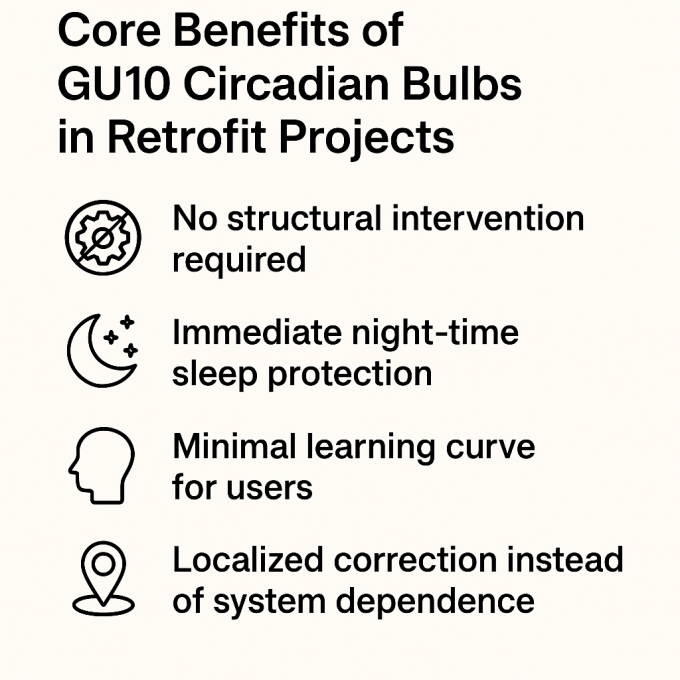
Retrofit projects succeed when improvements are simple, predictable, and measurable. GU10 circadian bulbs align naturally with these constraints.
The primary value of GU10 circadian bulbs in retrofit environments is biological improvement achieved with minimal physical and operational disruption.
No structural intervention required
Most retrofit buildings cannot accommodate changes to:
- ceilings
-
wiring routes
-
control cabinets
GU10 bulbs operate within existing sockets and circuits. This enables:
In hospitality, residential, and senior living retrofits, this factor alone often determines whether a project can proceed.
Immediate night-time sleep protection
Night-time lighting is the most common circadian failure point in existing buildings.
Replacing standard white GU10 bulbs with:
immediately reduces melatonin suppression by addressing the problem at its source: spectrum.
Harvard Medical School confirms that blue light in the 460–480 nm range suppresses melatonin, even at low intensity.
Source: https://health.harvard.edu/staying-healthy/blue-light-has-a-dark-side
GU10 retrofits remove blue-rich light rather than attempting to manage its effects through dimming or control logic.
Minimal learning curve for users
Retrofit users—guests, tenants, residents—resist behavioral change.
GU10 circadian bulbs:
People use the lights as they always have. This behavioral neutrality is critical in retrofit success and often makes GU10 solutions more effective in practice than complex systems that are misunderstood or bypassed.
Localized correction instead of system dependence
Retrofit projects rarely support centralized circadian control.
GU10 enables localized biological correction in high-impact zones:
Local biological problems do not always require system-wide solutions. In many retrofit cases, correcting a few critical zones delivers the majority of benefit.
Favorable cost-to-impact ratio
Full circadian or HCL systems incur cost through:
- new luminaires
-
control infrastructure
-
commissioning
-
long-term maintenance
GU10 circadian bulbs shift investment to the lamp level. This allows:
For retrofit buyers, this reduces both financial and operational risk.
GU10 Circadian Bulbs Compared with Full HCL Systems in Retrofit Contexts
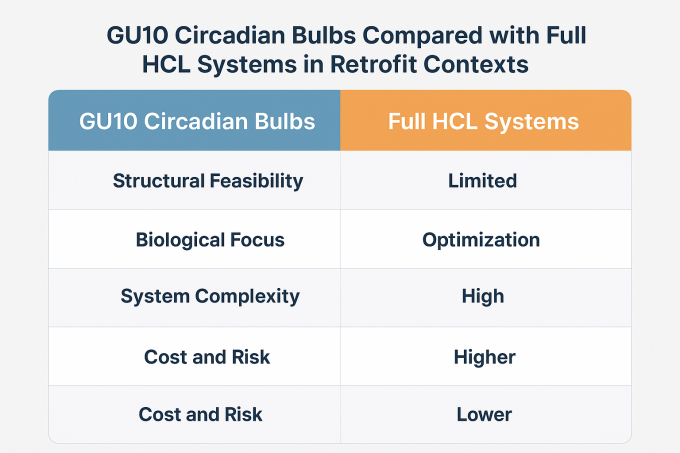
A common question is whether GU10 circadian bulbs can replace Human Centric Lighting (HCL) systems. They cannot—but this comparison often misses the real retrofit question.
In retrofit projects, GU10 circadian bulbs compete on reliability and feasibility, not on biological completeness.
Structural feasibility comparison
| Aspect |
GU10 Retrofit |
Full HCL System |
| Ceiling modification |
None |
Required |
| Rewiring |
No |
Yes |
| Control infrastructure |
No |
Yes |
| Installation timeline |
Hours |
Weeks |
| Operational disruption |
Minimal |
Significant |
Most retrofit environments cannot tolerate the structural and operational demands of HCL systems.
Biological performance focus
| Biological Objective |
GU10 Retrofit |
Full HCL |
| Night melatonin protection |
Strong |
Strong |
| Evening relaxation |
Moderate |
Strong |
| Daytime alertness |
Limited |
Strong |
| Full circadian entrainment |
Not achievable |
Achievable |
GU10 solutions focus on harm reduction, particularly at night.
HCL systems focus on biological optimization across the full day.
Retrofit projects almost always prioritize harm reduction first.
Different failure modes
Understanding how systems fail is critical in retrofit decision-making.
- HCL systems often fail due to:
programming drift
- sensor errors
-
user overrides
-
maintenance complexity
GU10 circadian retrofits typically fail due to:
unrealistic expectations
- continued use of white light at night
-
poor lamp placement
In retrofit conditions, simple systems fail less often.
Operational and maintenance reality
Facilities teams generally prefer:
GU10 bulbs align with this operational mindset. Many HCL systems fail not technically, but operationally.
Cost and risk balance
| Factor |
GU10 |
HCL |
| Initial investment |
Low |
High |
| Risk exposure |
Low |
Medium–High |
| Payback horizon |
Short |
Long |
| User acceptance |
High |
Variable |
In retrofit economics, lower risk frequently outweighs theoretical performance.
Retrofit Project Types Where GU10 Performs Best
GU10 circadian bulbs do not suit every retrofit scenario. They suit specific ones very well.
GU10 circadian retrofits are most effective where night-time comfort, sleep protection, and ease of implementation are primary goals.
Hospitality retrofits
Hotels rarely close rooms for lighting upgrades.
GU10 retrofits allow:
- room-by-room implementation
-
zero guest displacement
-
immediate guest feedback
Typical applications include:
| Area |
GU10 Circadian Role |
| Bedside |
Warm or amber lighting |
| Bathroom night mode |
Red GU10 |
| Corridors |
Warm, low-glare |
| Accent lighting |
Warm, indirect |
These interventions target guest sleep quality, which directly affects reviews and repeat bookings.
Serviced apartments and rental properties
These properties face:
GU10 circadian bulbs improve night-time comfort without altering infrastructure. Tenants experience the benefit even if they cannot articulate why.
Residential retrofit upgrades
Homeowners typically want better sleep, not lighting systems.
GU10 allows:
- DIY-friendly upgrades
-
incremental changes
-
low commitment
Replacing night-time GU10 bulbs with red or amber versions often produces the most immediate perceived improvement.
Senior living and assisted housing
Sleep disruption and night-time falls increase with age.
Red GU10 night lighting:
- protects melatonin
-
preserves night vision
-
improves safety
In these environments, night-time protection often matters more than daytime circadian stimulation.
Offices with limited wellness objectives
Offices pursuing basic wellness improvements can use GU10 to:
GU10 is not suitable for full daytime circadian stimulation but can reduce harm outside working hours.
Retrofit scenarios where GU10 is insufficient
Avoid GU10-only retrofit strategies when the objective is:
- full circadian entrainment
-
healthcare-grade biological lighting
-
productivity-focused daytime stimulation
-
certification-driven compliance
These goals require system-level solutions.
A Practical Decision Framework for GU10 Circadian Retrofits
Retrofit success depends on correct early decisions.
A simple decision framework helps determine whether GU10 circadian bulbs are an appropriate retrofit solution.
Step 1: Define the biological problem
Identify the primary issue being addressed.
| Problem |
GU10 Suitable |
| Poor sleep quality |
Yes |
| Night-time disruption |
Yes |
| Guest complaints |
Yes |
| Low daytime alertness |
No |
| Certification compliance |
No |
GU10 addresses night-time problems more effectively than daytime ones.
Step 2: Confirm structural constraints
If the project cannot:
- open ceilings
-
add control wiring
-
replace luminaires
GU10 becomes one of the few viable options.
Step 3: Identify time-of-day focus
GU10 performs best when the focus is:
- evening transition
-
night-time protection
If morning stimulation is the priority, GU10 is secondary at best.
Step 4: Evaluate user behavior
If users are likely to:
- ignore controls
-
override settings
-
resist learning
Simple GU10-based solutions often outperform complex systems in practice.
Step 5: Assess budget and risk tolerance
| Project Type |
More Suitable |
| Pilot or trial |
GU10 |
| Phased upgrade |
GU10 |
| Full renovation |
HCL |
| Certification-driven project |
HCL |
Step 6: Combine solutions when appropriate
Effective retrofits often mix approaches:
Circadian improvement does not require purity. It requires effectiveness.
Final reality check
GU10 circadian bulbs will not transform an aging building into a circadian showcase. They will:
- reduce biological harm
-
improve sleep quality
-
increase comfort
-
lower user complaints
In retrofit logic, that outcome defines success.
Conclusion
GU10 circadian bulbs offer a low-risk, high-impact approach to improving sleep and comfort in retrofit lighting projects where full circadian systems are impractical.
They succeed not by doing everything, but by doing the right things under real constraints.
Teco manufactures GU10 circadian-capable LED spotlights designed specifically for retrofit lighting projects in hospitality, residential, and senior living environments.
We work B2B only, supporting buyers who need realistic application guidance, verified certification, and stable delivery.
Our China-based factory operates four production lines and supports:
- warm, amber, and red GU10 solutions
-
stable low-level dimming for night use
-
OEM and ODM customization
-
compliance for Europe, Middle East, and Southeast Asia
If you are planning a retrofit lighting upgrade and considering GU10 circadian bulbs:
Email: [email protected]
Website: www.tecolite.com
Tell us your building type and constraints.
We will help you determine whether GU10 is the right retrofit choice—or whether it is not.


 Your message must be between 20-3,000 characters!