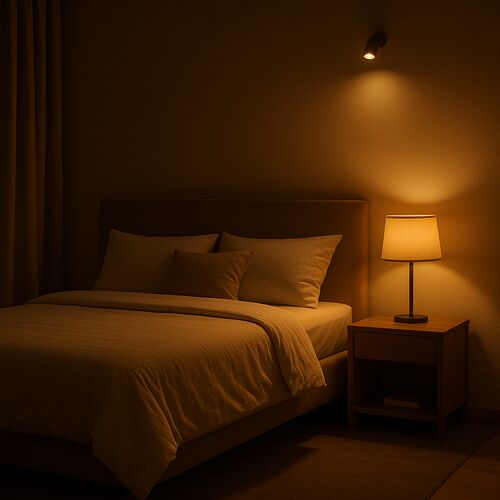
Many people invest in better mattresses, blackout curtains, and sleep trackers, yet still struggle with poor sleep quality. In most cases, the missing factor is not comfort or darkness—but lighting timing and spectrum.
Bedroom lighting directly influences melatonin release, alertness, and how efficiently the brain transitions into sleep.
When lighting is poorly designed, even short exposure can delay sleep onset and reduce sleep depth.
Bedrooms are the most sensitive environment for circadian mistakes. GU10 circadian-capable bulbs can support better sleep, but only when applied with correct design logic. This guide focuses on what works in real bedrooms—not laboratory conditions or marketing theory.
Biological Requirements for Night-Time Bedroom Lighting
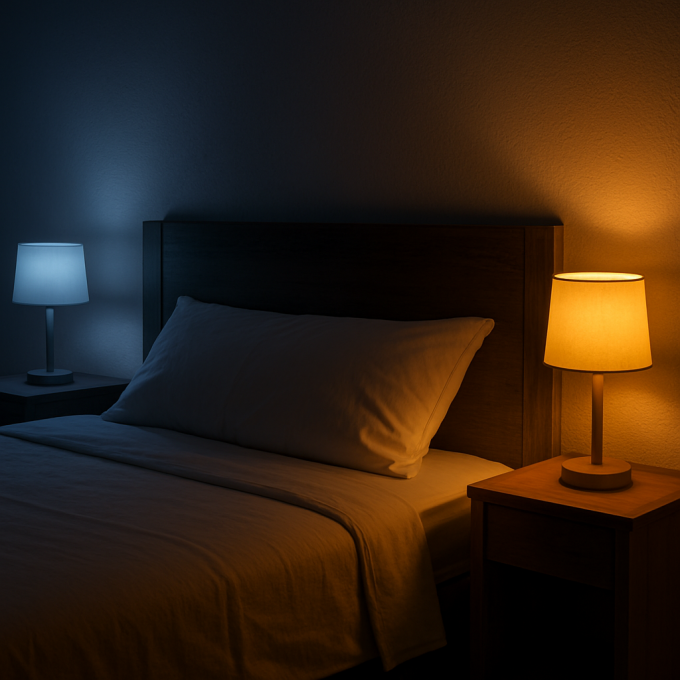
Most bedrooms are illuminated for convenience, not biology. This creates immediate conflict once lights are used after sunset.
Effective night-time bedroom lighting must provide orientation without triggering alertness.
What the human circadian system expects at night
After sunset, the body looks for three consistent signals:
When these conditions are met, melatonin production rises naturally.
Harvard Medical School confirms that blue light in the 460–480 nm range suppresses melatonin, even at relatively low intensity.
Source: https://health.harvard.edu/staying-healthy/blue-light-has-a-dark-side
This means the problem is rarely “too much light.”
It is almost always the wrong spectrum.
Common bedroom lighting failures
Many bedrooms still rely on:
These solutions are acceptable during daytime hours but biologically disruptive late at night. Even brief exposure can:
What night-time bedroom lighting should achieve
A biologically appropriate bedroom light at night should:
- avoid short-wavelength blue light
-
stay below circadian stimulation thresholds
-
support orientation rather than task activity
-
never cause sudden visual contrast
GU10 circadian bulbs are effective here—not as primary lights, but as controlled, low-impact tools.
Why GU10 Circadian Bulbs Work in Bedrooms
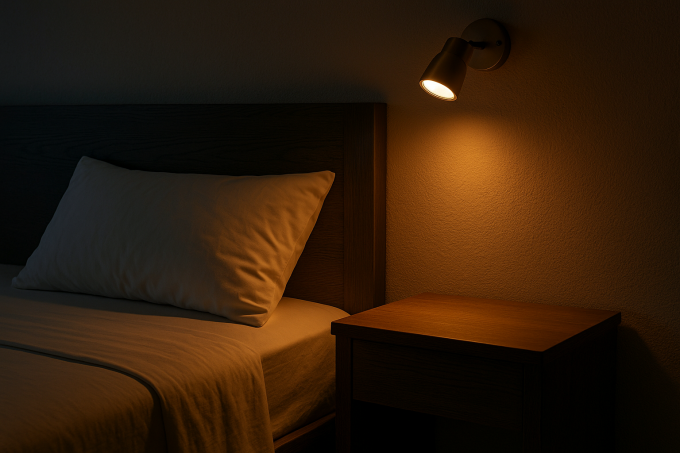
GU10 lamps are often underestimated in circadian lighting design. Their limitations are precisely what make them suitable for bedrooms.
GU10 circadian bulbs are effective because they deliver localized, low-intensity light without flooding the room biologically.
Directional control over exposure
GU10 lamps are:
- compact
-
directional
-
easy to zone
-
easy to dim
Circadian response depends on vertical illuminance at eye level, not total room brightness.
Source: WELL Building Standard v2
https://standard.wellcertified.com/light
A ceiling panel exposes the eyes directly.
A properly positioned GU10 does not.
Appropriate bedroom use cases for GU10
GU10 performs best in the following roles:
- bedside transition lighting
-
floor-level night navigation
-
wardrobe or bathroom path lighting
-
indirect accent lighting behind headboards
These applications preserve functionality while minimizing biological impact.
Spectrum choices that support sleep
For bedroom use, GU10 circadian bulbs should fall into three spectrum categories:
| Light Type |
Typical Use |
Biological Impact |
| Warm white (≈2700K) |
Evening wind-down |
Low stimulation |
| Amber |
Late evening |
Very low stimulation |
| Red |
Night navigation |
Near-zero impact |
White GU10 bulbs above 3000K should be avoided late at night.
Dimming alone does not eliminate biological disruption.
When GU10 limitations become advantages
GU10 cannot deliver strong circadian stimulation across an entire room.
In bedrooms, this is an advantage.
Sleep environments require restraint, not intensity.
Layered Bedroom Lighting Strategies Using GU10
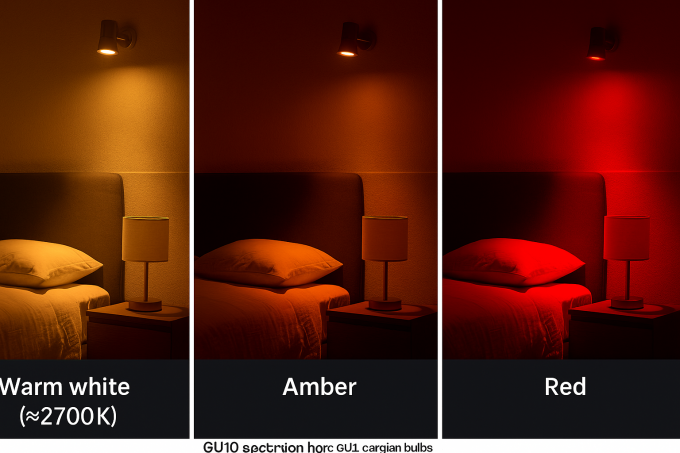
Effective bedroom lighting is layered. No single light should serve all functions.
Successful designs use GU10 circadian bulbs in time-based layers aligned with sleep biology.
Evening transition layer
Evening lighting should support relaxation, not immediate darkness.
Best practice:
Avoid overhead downlights or narrow beams aimed toward the bed.
Bedside reading without circadian disruption
Reading in bed does not need to compromise sleep.
Recommended setup:
- warm GU10 with wide beam (≥36°)
-
shielded fixture
-
downward-directed light
Light should never spill directly onto the face.
Easy-off control is essential.
Night navigation layer (critical)
This layer protects sleep most effectively.
Between late evening and sunrise:
- use red GU10 bulbs
-
place below knee height
-
keep output minimal
Research by Brainard et al. shows red light does not suppress melatonin, unlike white or amber light.
Source: Brainard GC, Journal of Neuroscience, 2001
This allows safe movement without neurological activation.
Bathroom path lighting
Bathrooms are one of the most common sleep disruptors.
Incorrect approach:
- bright white ceiling light at night
Correct approach:
This single change often improves sleep more than any mattress upgrade.
Morning transition separation
Bedrooms should support mornings, not resist them.
Avoid red light after waking.
Introduce neutral or warm white gradually using:
- separate circuits
-
scheduled switching
-
clear user habits
Design should support behavior automatically, not rely on memory.
Residential vs Hotel Bedroom Design Logic
Homes and hotels share the same biological goals, but require different control strategies.
Residential bedrooms allow personal learning, while hotel bedrooms must be error-proof.
Residential bedroom approach
Home users can tolerate manual control and habit formation.
Recommended residential zoning:
| Zone |
Light Type |
| Main ceiling |
Warm white, limited use |
| Bedside |
Warm GU10 |
| Night path |
Red GU10 |
| Bathroom night |
Red GU10 |
Flexibility is acceptable, but simplicity still matters.
Hotel bedroom approach
Hotel guests will not learn systems.
Lighting must default to safe behavior.
Best practice:
Guests rarely complain about red light.
They complain about poor sleep.
Control philosophy differences
| Aspect |
Residential |
Hotel |
| User education |
Possible |
Impossible |
| Automation |
Optional |
Preferred |
| Error tolerance |
High |
Low |
| Default safety |
Flexible |
Critical |
Hotel lighting must remain safe even when every switch is pressed at 2am.
Why GU10 fits hotel retrofits
GU10 enables:
- fast retrofit
-
minimal rewiring
-
localized intervention
-
low maintenance
Replacing selected GU10 bulbs can measurably improve sleep quality and guest satisfaction without renovation.
Conclusion
GU10 circadian bulbs improve bedroom sleep quality when used as low-impact, time-based lighting layers that respect night-time biology rather than override it.
They are not substitutes for architectural circadian systems—but in bedrooms, restraint, control, and spectrum discipline matter more than intensity.
Designing for sleep means designing for how the brain powers down, not how the room looks.
Teco designs and manufactures GU10 circadian-capable LED spotlights for bedroom applications in hospitality and residential projects.
We work B2B only, focusing on real-world biological performance—not marketing claims.
Our China-based factory operates four production lines and supports:
If you are designing bedroom lighting for better sleep:
Email: [email protected]
Website: www.tecolite.com
Tell us whether your project is residential or hospitality.
We will help you choose what genuinely supports sleep—not what only looks correct on paper.


 Your message must be between 20-3,000 characters!